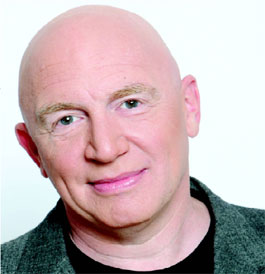
- Dr. Strenger, why did you start studying the Phenomenon that you call "Fear
of Insignificance"?
In the late 1990s, I began to notice that my clients became ever more
concerned whether they were leading lives of significance, and there were ever more reports in
the research literature on a rise of depression and anxiety. I was wondering why this
was happening, particularly because many of my clients led interesting and rewarding
lives: many of them were high achievers, some of them are celebrities. Nevertheless,
they were anxious that they weren't doing well enough; that they were not
leading meaningful lives. I presented preliminary results in my previous book, The Designed Self (2004), but felt that a more interdisciplinary approach
was needed to fully understand the phenomenon.
- How is today's fear of insignificance expressed?
I think we live in a time in which people live under
strong pressure to live spectacular lives. You see, people who
are doing quite well: executives, lawyers, physicians, who feel
that they are missing out something. Many of them feel their
lives are grey; they feel they are not getting enough out of life.
They feel they need to do extraordinary things, primarily
in their careers, but also in their private lives. They feel that
they need to participate in extreme sports, amass lot
of experiences, as otherwise their lives are devoid
of insignificance. They keep comparing their lives to
the spectacular success stories of global celebrities _ and
they often feel that in comparison, their lives are not
of significance.
- You claim that the fear of insignificance is
exacerbated by today's celebrity culture. Could you explain
the connection?
The global infotainment system is in need of global
celebrities that can, at least potentially interest the global audience.
Who matters in the global world, and who doesn't? And how
does the infotainment system determine who matters? In a field
of comparison that spans the earth's population, we
gravitate towards quantitative measures, and basically there seem
to be two major parameters that can be measured easily:
fame and wealth.
As a result a new craze has evolved: an endless thirst
for ranking and rating scales. These matter, first and
foremost, economically. Brands by definition need to stand out. But
now human beings have basically become brands as well.
The infotainment system needs to know whose endorsement
will matter. They matter politically: without
name-recognition, you stand no chance of being elected. Celebrity is
everything, now.
Our culture, addicted to global success stories, is making
it increasingly difficult for the overwhelming majority of
people who make a decent living through hard work, but do
not belong to the global ruling class, to feel that they
matter, because of the global infotainment system.
- Celebrity has indeed become a huge phenomenon.
How do you explain this psychologically?
In our age of global infotainment networks, celebrity is
the new Holy Grail, the road to immortality, even though it
is often not even based on extraordinary achievement.
No
phenomenon illustrates these dynamics more than the advent of reality TV that
has become the single-most powerful factor that has changed the landscape of Television in
the last decade. Reality shows were the top-rated programs on American TV in most years
since 2000, with Survivor and American Idol leading the charts. Currently, the four
national broadcast networks, ABC, CBS, NBC and Fox all plan to have at least one prime-time
reality show a year.
Reality TV focuses on the process of transformation that turns an ordinary mortal
into a demigod. This process is normally hidden from the spectator's eye. We are not privy to
the process that has turned Brad Pitt and Angelina Jolie, George Clooney and
Scarlett Johansson into celebrities. We only see the end result of the human already
transformed into a demigod. But our culture is obsessed with this transformation; we want to see
the miracle happen.
The success of Reality Show on TV is based on its focus on the process of the
magical transformation of a human being from the status of an ordinary mortal to the status of
a demigod. Followed by countless cameras, we can watch the process of
transubstantiation, the moment in which a human being is touched by grace.
- But the desire for fame is not new, is it?
It is an age-old phenomenon that has taken a new, more extreme form. Almost all
great philosophical systems of the world have pointed out that the deepest problem humans
face is the fear of death. Modern Experimental Existential Psychology (EEP) has shown that
this is indeed true, and that one of the most important functions of culture is to give us a
sense that our lives matter; that we will not disappear from this world without a trace.
The desire for fame is one of the ways humans have to deal with the dread of death, and
it is, of course, not new. The heroes of Greek mythology were willing to risk their lives to
enact feats of bravery that would make them famous forever. Behind this there is one,
big universal fear: the terror of dying.
The frame of reference. An ancient Greek hero or poet, felt that if the Greeks would
sing about him or her forever that would be fine. And so it was most of the history of
humanity. Two generations ago, lawyers, doctors or executives who were respected by their
immediate community, felt that their lives mattered.
This has now changed. The global infotainment network that has connected us to all
corners of the world has created a new species that I call `Homo globalis', defined by its
intimate connection to this network.
- Do you think that Homo globalis is indeed a new phenomenon?
Yes. No generation of the past had such immediate access to the whole world, not
just through text but through images and videos as ours. My point is that, while this
network has changed something dramatic in our culture, our basic, archaic fear of death, and
our yearning to live lives of significance hasn't changed. But it is more difficult to feel that life
is significant today.
- Does being a celebrity, indeed, provide relief from the fear of insignificance and
of finitude?
Celebrity, in anything, should be associated with evanescence rather than immortality, but
it isn't. The age-old association between fame and immortality, illusory as it may be, retains
its power over our minds as the promise that we can escape our fear of insignificance
and
finally feel that we are valuable human beings. It may seem preposterous to think
that celebrity has anything to do with the striving for symbolic immortality. Yet celebrities
are invested with a special aura. Hundreds of millions will continue to watch how
ordinary mortals become demigods _ and will hope that, one day, they will become immortal
as well. Fans seek to touch or physically see celebrities in the same way as the faithful want
to touch the relics of a saint or the hand of a high ranking cleric.
Celebrities are invested with very special powers, even though it is somewhat more
of an earthly sort. Early in the 20th century, the fledgling film industry found out that
the fame of an actor could become the central selling point of a movie. Now, a century
later, Hollywood megastars get paid upto $20 mn plus a percentage of profits, for the
simple reason that their names are the crucial factor in determining a movie's success.
But the striving for glory is not primarily motivated by material gain. Glory is
primarily sought because as humans we seek to matter. We want to be significant, and ultimately,
we want to be immortal.
The paradox of contemporary celebrity is that it has become more and
more evanescent. The latest evictee of `Big Brother' or `Survivor' may well acquire great
celebrity for the proverbial fifteen minutes, and millions may watch his or her final interview.
But chances are that their names will no longer be remembered the day after.
- How does the celebrity craze and the ranking systems influence us as
human beings?
Ranking systems have influenced the self-esteem of all Homo globalis. The new principle
is `I am ranked; therefore I am'. The desire for fame is as old as humanity. From the
moment that humans became aware of death, the desire for immortality is as old as
human awareness of death. The Homeric heroes were willing to sacrifice their lives for deeds
that would be remembered forever; fame, has always been one of humanities favorite ways
to ensure immortality, if only symbolic.
In our age of global infotainment networks, the Holy Grail is to appear in some
ranking system. It starts from the influential global lists, like the TIME list of the100 most influential persons in the world. It continues through the various lists of the
wealthiest, sexiest, best-known of the globe, the continent, the country _ or at least the city.
This is making life difficult for the overwhelming majority of Homo globalis who
are obviously not included in the big ranking systems. This greatly reinforces our fear
of insignificance.
We are all flooded by the stories of Bill Gates, Mark Zuckerberg, Brad Pitt, and
Angelina Jolie. We keep hearing about what they do; how much money they make; how they
impact the world. That, of necessity begins to raise the question: how do I compare to that?
- But can't we simply disregard these global success stories? Isn't this just about
a few people obsessed with success?
I think it's become almost impossible to withstand the onslaught of information
about global success stories. Even if you just read your local paper, you will read about
Mark Zuckerberg, Bill Gates, Angelina Jolie and Justin Bieber. You just can't avoid knowing
about them.
In addition, the new global upper class impacts our lives in very concrete ways.
Cities that house the large multinational companies' headquarters have become unaffordable
for a growing number of people. The new upper class of global corporate executives has
driven
real estate prices and rent through the roof into stratospheric heights. The second
impact is psychological. I have, for example, worked with physicians who felt deeply frustrated.
I have studied and specialized for fifteen years, and have started to make money only now.
I feel like a complete idiot when I look at my classmates who dropped out of medicine
and moved to some biotech companies or a fund that invests in them. They have more
money now than that I'll make in a lifetime!
These physicians represent the larger group of the traditional professions who
feel largely disenfranchised. First they feel financially stressed. They need to work very hard
to just get their kids through college, and they still feel that they have difficulties
maintaining the lifestyle that they were expected to lead when they chose their professions. They
also feel that the status they expected when they entered their professions eludes them.
Added to this, many professionals have lost their independence through the new
global developments. For lawyers, it is becoming increasingly difficult to be competitive in
a market that has come to be dominated by ever larger firms who are able to provide
24/7 services, providing their global clients with legal services at very high speed. The same holds
true for consultants, accountants and advertisers whose environment has changed dramatically
with the advent of global firms like McKinsey, Ernst and Young and McCann Erickson.
- What are the ways to deal with this increased fear of insignificance?
One pervasive phenomenon that has emerged is to establish a presence in cyberspace.
One of the reasons for the immense popularity of Facebook is, it has made possible for those
of us who are under the radar of the large ranking systems to compete at least through
the number of "friends" they have on their profile. I've just read that India is joining this
trend as well with more than 23 million Facebook users, and the number is growing very fast.
Another is the striving for spectacular achievement about which we spoke at the
beginning of this interview. You see how more and more people feel that they need to reach for
the stars. To settle for a decent career to many, feels as they are chickening out; that they
are not trying to go for all of it.
This is strongly reinforced by the myth expressed in Nike's phenomenally
successful advertising campaign `Just do it!' Its message is: not reaching for the stars is to settle
for mediocrity. Limitations are there to overcome; not to be accepted. I should add that
Nike has of course not created this culture: it connected to it very effectively and expressed
its spirit in this slogan.
- Does this impact the minds and the behavior of corporate executives?
It does; enormously so. About a year ago, I published an article in Effective Executive, called `After the Age of Omnipotence' in which I argued that this pressure for
extraordinary achievement has contributed greatly to the last financial meltdown. Executives were
under enormous cultural pressure to bring in huge results. Corporations kept looking
for celebrity CEOs who promised phenomenal growth and profits. The results, particularly
in the financial sector, were deleterious, as you know.
- Dr. Strenger, what cures do you suggest for this celebrity craze and the `Just Do
It' culture?
The first and most important process is what I call active self-acceptance. I am opposed
to the idea that we have no limitations. We all do. This doesn't mean that we should not
all strive to realize our potential optimally. But self-actualization requires knowing what
our potential is. All of us are good at some things, and less so at others; we all enjoy
certain activities, and don't enjoy others. Trying to mold ourselves along the lines of the
latest celebrity is likely to create a lot of frustration and suffering, for a number of reasons.
First: for purely statistical reasons 99.9999% of us will never be global celebrities; building our
self-esteem on purely comparative measures means that we will feel like a commodity traded
on the global market, with constant fluctuations.
Second: the celebrity culture has made it almost a dogma that we all want to be
famous or need spectacular achievement. But this may not suit our real needs at all. I'll give you
a simple example: many people think `I would like to be very famous; I would like to
be admired; I would like everybody to want to know about me.'
In my psychological practice, I have worked with quite a few celebrities. What people
are not aware of, mostly, is how stressful being a celebrity can be. Enormous pressures
are involved; it is very difficult to truly keep a private life. You are constantly required to live
up to the standards that are now expected of you. If the rating of your show goes down, all
the papers will write about it.
So the first step in active self-acceptance is a certain amount of calm, objective
self-knowledge. We need to be honest about our strengths and weaknesses. This will help us
in determining what we are likely to be good at; and what not. We need to be honest
about this: do we really want this? Would we really live well with such pressure? So the first step
is to look in the mirror and see who we truly are.
- Isn't `Active Self-Acceptance' an elegant way of saying that we should accept
our limitations, even if this means mediocrity?
No. I believe that the source for living a meaningful life is to focus on what is
intrinsically meaningful to us, and be less obsessed with comparing ourselves to others. While
there is no way to avoid comparison, we know from research that the experience of
meaning doesn't derive from this: it derives from deep involvement in activities that we
truly value.
The process of concentrated, sustained creation is likely to engender the state of
mind, that psychologist Mihaly
Csikszentmihalyi1 who has researched this for three
decades, has called `Flow'. By this he means the state of total immersion in an activity in which
a person is highly skilled, and experiences as meaningful and valuable. Through
ongoing research for more than thirty years Csikszentmihalyi has come to the conclusion
that `flow' is the state most highly correlated with a general feeling of happiness.
Flow is primarily characterized by a lack of self-consciousness. Re-emerging from a
flow experience we are likely to say something like `I wasn't aware of myself for hours!'
Flow therefore counteracts two aspects of the human condition that strongly associates
with existential terror: self-consciousness and awareness of time. Flow liberates us
from awareness of self and time; it allows us to be immersed in an activity that we experience
as intrinsically meaningful.
- Does Flow - the immersion in meaningful activity - help us to accept our limitations?
It makes us stop thinking about them; we are involved in what we do rather than
thinking about who we are and how we compare to others. The second, tremendously
important factor in wellbeing is, of course, love, friendship and a sense of community. These do
not depend on numbers; they depend on close relationships and research shows these to
impact happiness and a sense of significance much more than success.
- I'm still not sure that our readers will not think that you simply say not to
worry about mediocrity.
I appreciate your insistence. But let me say something about the deep philosophical
mistake that fuels the difficulty of self-acceptance. We need to drop the mistaken notion
that freedom consists of lack of limitations perpetuated by the global infotainment system. We
all need to make choices, and to commit to what matters to us. Such commitment means
that we accept there will be many things we won't do in our lives. For some of us, this means
that we renounce riches; for others it means that we renounce fame; others again, take
great responsibility upon themselves, which can often mean less peace of mind. There is always
a price to be paid. The model of active self-acceptance goes against the grain of our
increasingly global consumerist culture. It is a model that, in the midst of surging concerns about
natural and human ecology, may prove to be important for this troubled time in human history.
- It seems that active self-acceptance requires quite a bit of intellectual and
emotional work.
Of course it does! But why should anybody think that something as central to our
wellbeing and important to our lives as our self-esteem should come for free without any work?
It's fascinating to me that people easily accept that in order to be fit they will have to put in a
lot of work. Nobody expects to stay fit by working out for two months, and that this will last
for the rest of our lives.
Putting our lives into focus requires a stable meaning system that puts order into
our values. We cannot center our lives around a theme without having a worldview that tells
us what is important and truly valuable, and what is nothing but a distraction that must not
tie up our energies. But people seem ever less willing to invest energies in their worldviews.
- Dr. Strenger, could you explain what you mean by investing in a worldview
and elaborate on your claim that Homo globalis are less likely to do this?
Let me start by describing a recent trend that we are noticing in Western countries, and
I'd love to know whether there is a similar phenomenon in India. At Western Universities we
are seeing a decline in enrollment in the humanities; people see intent only to invest in
pragmatic disciplines like business administration, computing, engineering etc. Philosophy,
history, political and religious studies, literature, and art simply don't seem to be practical enough
for people. Many homo globalis invest a great deal of energy in achieving skills that will
further make their careers; while they invest ever less time and energy on matters pertaining to
basic existential issues. Philosophical questions seem to be a waste of time; investing time
in understanding your own and other cultures seems not to contribute to your career; so
why
should waste the time? But then comes the really important moments in life when
you need to make crucial decisions. Who do I want to be, what do I want to do? Who do I
want to live with; to marry? How am I supposed to decide this? There are other crucial
moments in our lives; moments of crisis and loss: we lose loved ones; parents, friends. We
face mortality, illness, death. How are we supposed to deal with this?
- Are these not the moments to take help of religion?
It certainly does _ for those who have unquestioned belief in an established religion.
But homo globalis, because of their access to worldwide information, are often aware of the
fact that there are many religions; they are less likely to adhere to a religious
tradition unquestioningly, because they have more global awareness. This, to some extent, is
quite positive, because it counteracts fundamentalist intolerance. India, like Israel, knows
how terrible religious conflict can be; and awareness and tolerance of other religious groups is
a virtue that we should praise.
But this means that many homo globalis are left with little philosophical and
spiritual resources when they need them. What tends to happen nowadays is that people then
turn to quick-fix pseudo gurus; people who claim that they have quick-fix methods that
will make you feel secure, meaningful and valuable in seven days practicing a few minutes a
day. But lo and behold, none of this works.
This should of course not surprise us. It doesn't matter whether you look
at philosophies of India, China or Europe. Great spiritual and philosophical schools of all
major cultures have emphasized that developing your mind, a philosophical worldview and
the ability to evolve spiritually and intellectually requires lifelong work.
Developing a stable worldview is not like buying a product off the shelf. It's more
like acquiring a very complex ability like becoming an accomplished pianist, tennis player,
lawyer or physician. Nobody expects to achieve this quickly just by repeating some simple
mantras. It takes time for these skills to evolve.
- So, in addition to active self-acceptance, homo globalis should invest more
in philosophy, history, religious studies and the like?
Yes, definitely. This is of tremendous importance, and is more likely to help in
overcoming the fear of insignificance than focusing exclusively on high achievement. But it must be
clear that there is no way to evolve this worldview-stability without investing a lot of time in
this _ for life _ not just for a few days.
All major civilizations realized this, to become a truly free human being requires a
lot of investment. That's why an education conducive to personal freedom is often
called liberal education. I think our global culture is losing track of the tremendous value
of liberal education for wellbeing, and we need to think about how we can reinstate
its value.
Paradoxically, it is also likely to help in achieving more. It turns out that people
who have a wider knowledge base across different disciplines are more likely to come up
with creative solutions to complex problems.
The interview was conducted by
-- Ivaturi Murali
krishna
Research Associate, Effective Executive
IUP Publications
Reference # 03M-2011-06-06-06