May 2023
The Analyst Magazine
The Global ANALYST is one of India?s leading business & finance magazines.?The Global ANALYST, a monthly magazine, contains intellectually stimulating articles on cutting-edge and contemporary topics. Besides, it also features interviews with as well as articles written by eminent national and international experts from industry, academia (including IIMs and IITs), as well as regulatory bodies (like RBI), etc., encompassing areas such as financial markets, economics, strategy, international trade, banking, technology, start-ups, e-commerce, industries, to name a few.
First Cut
Reliance Retail has entered into the beauty segment with the launch of Tira, an omnichannel beauty retail platform.
With this, the retail giant joins the list of companies such as HUL (which owns Lakme), Nykka, Tata, and LVMH's
Sephora, which have a significant presence in India's fast-growing beauty and personal care market. The company
signaled its entry into the segment with the launch of its first flagship Tira store, which opened recently at Jio World Drive in
Bandra Kurla Complex in Mumbai. It is reportedly mulling to launch more such stores across the country in the time to come.
At these stores, consumers can find a range of the best global and home-grown brands. Apart from its offline presence, the
company is also aiming to capture eyeballs through a strong digital presence. The retailer recently debuted its website, besides
taking its Tira App live in over 100 cities. With Tira, Reliance Retail Ventures Ltd. (RRVL) takes its game a notch up, as it
looks to leverage technology to offer an unparalleled shopping experience to potential consumers. For example, customers
visiting its store can find a number of consoles to assist them in shopping. One such console is a beauty vending machine, which
lets a user to pick a free product sample and collect it simply through OTP-based registration, which experts say, is bound to be
a major center of attraction. The Tira beauty store also allows users to try their makeup in various lights through its 'Smart
Mirrors' which have switchable lights. They let you try on the makeup products in various lights, from warm to white.
It is
further connected to a tablet that analyzes the user's skin and rates it on various scales, like dullness, UV damage, and oiliness,
and also calculates the skin's age. Depending on the results, a skincare regime and makeup products can be bought. Then there
is also a hair care station, which is powered by Dyson, where you can get a quick hairdo just by registering for a Dyson experience
and without having to buy anything in the store. Upping the ante, Tira also offers a tech-enabled service-a first in India-the
Fragrance Finder, an AI-powered console that helps consumers match fragrances closest to their preferences. The Tira store at
Jio World Drive is spread across 4,300 Sq. ft and has been designed by London-headquartered innovation studio Dalziel & Pow.
Speaking on the occasion, Isha Ambani, Executive Director, RRVL, said, "We are excited to bring the Tira experience to our
Indian customers. With Tira, we aim to break down barriers in the beauty space and democratize beauty for consumers across
segments". She added, "Our vision for Tira is to be the leading beauty destinations for accessible yet aspirational beauty, one
that is inclusive, and one that harbours the mission of becoming the most loved beauty retailer in India." RRVL is the holding
company of Reliance Retail. As per the company, Tira stores will be destination with a focus on curated services and the
consumer experience provided by beauty advisors. "The unique store experience will feature the latest beauty tech tools, such
as virtual try-ons to create customized looks and a skin analyzer that will personalize and assist consumers in making
purchasing decisions based on their needs. In addition, Tira stores will have dedicated gifting stations to personalize purchases,"
a statement from the company said. According to the online market and consumer data platform Statista, India's
beauty and personal care market is currently estimated at $27 bn. It expects 12.7% of the total revenue to be generated through
online sales. As per the latest report by market intelligence firm IMARC, the beauty and personal care market in India is
expected to grow from $26.3 bn in 2022 to $38 bn by 2028.
Tupperware shares eroded close to half of their value on a single day-April 10-after the direct selling company issued a bleak warning that its future is looking murky. Shares of the company have fallen by 92% over the past year and by more than a third so far this year, led by a combination of negative news. The fact that the firm missed the deadline to file its annual report did not help its cause either, with an infuriated New York Stock Exchange warning that Tupperware's stock was in danger of being delisted.
A flurry of negative news has hit the firm's shares hard. Early this April, in a major disappointment, the food storage container maker, in its delayed regulatory filing, said there's "substantial doubt about the company's ability to continue as a going concern. Though it has reassured investors that it's working with financial advisers to secure new financing to stay afloat, its shrinking sales and recent string of losses put a big question mark over its ability to survive for long. Nevertheless, to find a way out of the current quagmire and revive its sagging fortune, the embattled container maker has engaged the services of a slew of advisers, including investment bank Moelis & Co., law firm Kirkland & Ellis, and turnaround management firm Alvarez & Marsal. Yet, a section of critics feels that alone may not be sufficient, although the firm has said it is also exploring layoffs and divestment of non-core assets such as real estate as potential money-saving efforts. During the last quarter of the fiscal year ended December 31, 2022, the company's sales were down by a fifth on a year-overyear basis to $313.7 mn, while losses from continuing operations more than doubled to $35.2 mn from $15.4 mn in the prioryear period.
Given that, the billion dollar question is: Can the company avoid the inevitable? The company's top bosses sound confident. "Tupperware has embarked on a journey to turn around our operations, and today marks a critical step in addressing our capital and liquidity position," the company's CEO Miguel Fernandez recently said in a press release. "The company is doing everything in its power to mitigate the impacts of recent events, and we are taking immediate action to seek additional financing and address our financial position."
Tupperware, founded in 1946 and based on an idea by the founder Earl Tupper, revolutionized kitchenware markets in the West and much later this part of the world, offering colorful storage containers with airtight caps and going on to pioneer a plethora of other product segments such as tiffin boxes, water bottles, etc., has, however, of late failed to create the same kind of magic and connect with younger audiences who demand trendy and cool products. As a section of market analysts point out, several issues are hurting Tupperware, including a "sharp decline in the number of sellers, a consumer pullback on home products, and a brand that still does not fully connect with younger consumers," said Neil Saunders, Retail Analyst and Managing Director at GlobalData Retail. Speaking to CNN, he observed, Tupperware is in a "precarious position" financially because it's struggling to grow sales, and because it's asset-light, it doesn't have "much capacity to raise money." According to him, "The company used to be a hotbed of innovation with problem-solving kitchen gadgets, but it has really lost its edge."
Can it prove its critics wrong? Only time will tell. Meanwhile, in a move to strengthen its distribution and reach out to more consumers, Tupperware has entered into a distribution tie-up with leading the US retailer Target. As per the company, the entry into Target is part of the brand's reinvention, which includes plans to grow the business through multiple retail channels and get its products in front of younger consumers who've never even heard of Tupperware parties. Let's hope it doesn't become yet another victim of the pandemic-induced slowdown and bounces back strongly.
To mark its over a quarter-century-old association with India and Indian consumers, Apple has opened its first-ever retail stores in the country, launching new environmental initiatives, and highlighting the rapid growth of the Indian developer community. Apple's CEO, Tim Cook, expressed his excitement about the company's mission to "enrich lives and empower people around the world" and praised India's vibrant culture and energy. "India has such a beautiful culture and incredible energy, and we're excited to build on our long-standing history-supporting our customers, investing in local communities, and working together to build a better future with innovations that serve humanity," Cook said.
Apple's first of the two retail stores in India opened on April 18 at Mumbai's bustling Bandra Kurla Complex financial, arts, and entertainment district, while the second store was launched a few days later on April 20 at Saket, Delhi, inviting customers from all over the country and around the world to discover the best of Apple. Apple BKC will serve as a dynamic space where customers can come together, explore Apple products and services, enjoy exceptional service, and learn how to get more out of their devices through free Today at Apple sessions, according to the firm's website.
"At Apple, our customers are at the center of everything we do, and our teams are excited to celebrate this wonderful moment with them as we open our first retail store in India," said Deirdre O'Brien, Apple's Senior Vice President of Retail. "Apple BKC is a reflection of Mumbai's vibrant culture and brings together the best of Apple in a beautiful, welcoming space for connection and community." Apple BKC will offer a special Today at Apple series, "Mumbai Rising," running from Tuesday, April 18-the store's opening day-through the summer. Bringing visitors, local artists, and creatives together, these free sessions featuring Apple products and services will offer hands-on activities that celebrate the local community and culture. Sessions in the "Mumbai Rising" series include:
Apple BKC is designed to be one of the most energy-efficient Apple Store locations in the world, with a dedicated solar array and zero reliance on fossil fuels for store operations. The store is operationally carbon neutral, running on 100% renewable energy.
Apple opens its first India store one-and-a-half decades after the world's most lovable consumer technology company made its China retail debut (in 2008). In 1993, Apple opened its first flagship store at its Campus in Cupertino, California, while its first store outside the US was opened in Tokyo in 2003. Meanwhile, Apple's India retail chain foray also signals the coming of age of India's app developer community. According to Apple, India's thriving app developer community now supports over one million jobs, with App Store payouts to Indian developers tripling since 2018. Apple's iOS App Design and Development Accelerator in Bengaluru has hosted sessions for more than 15,000 developers since 2017, helping them take their apps from good to great and bring cutting-edge creations to the market, according to the technology giant's official India website.
The move also coincides with Apple's growing focus on making India one of its largest manufacturing bases outside the US and a part of its China Plus One vision. It is to be mentioned that it's been more than half-a-decade, or 2017 to be precise, since Apple began manufacturing some of the models of its flagship iPhones in India. The Cupertino, California-based tech behemoth has since worked with a number of domestic and international suppliers to assemble iPhone models such as the 11, 12, 13, and 14, and produce a growing number of components in India. This collaboration with Indian suppliers supports hundreds of thousands of jobs across the country, says the company, which currently has less than 5% market share in what is the world's second-largest market. However, it aims to grow it significantly as it firms up its India manufacturing plans. Earlier, in September 2020, Apple also launched its India online store, which Cook said helped the company's performance the following quarter. "Last quarter (October-December 2020) was the full first quarter of the online store. According to a JPMorgan report released in September 2022, Apple may make one out of four iPhones in India by 2025. The report claimed that Apple could shift 25% of its global iPhone production to India by 2025.
POLICY
FTP 2023
The Dawn of the Export Era?
FTP 2023 is forward-looking and envisions boosting manufacturing in India while also providing a vision to
exponentially increase India's share in the global supply chain.
- By Kavita Arya, Chief Manager (Research), State Bank Staff College, Hyderabad
Based on the four pillars of incentive
to remission, export promotion
through collaboration, ease
of doing business, and emerging areas,
the Foreign Trade Policy (FTP) 2023,
announced on March 31, 2023, by the
Minister of Commerce and Industry,
Piyush Goyal, ticks most of the boxes
for all the stakeholders. Alongside being
responsive to the emerging needs of
the time, the policy is a continuity to the
time-tested schemes. A document that
is nimble and responsive to the needs of
trade and exports, is based on the principle
of trust and partnership with the
exporters. FTP 2015-20, which was to
end on March 31, 2020, had to be extended
due to the Covid pandemic and
also due to the volatile geo-political
wise. Continuous feedback and incorporating
changes based on need
is a unique feature of the new FTP
2023. A responsive system based
on emerging situations and a dynamic
policy aim at catering to the
ever-evolving ecosystem of trade
and compliance. Some of the thrust
areas are:
1. In order to aid in the ease of doing
business for exporters, FTP
2023 aims at process re-engineering
and automation.
Emerging areas like dual-use
high-end technology items under
Special Chemicals, Organisms,
Materials, Equipment,
and Technologies (SCOMET),
collaborating between states
and districts for export promoconditions
till March 31, 2023. The FTP
2023 comes with no end date, and any/
subsequent changes may be done based
on need.
STARTUP XPRESS
The Race for AI Supremacy: IT's Advantage India
The Race for AI Supremacy: IT's Advantage India
India Trumps South Korea to emerge as the 5th-largest market in terms of investments in AI-based startups.
India is the fifth-largest destination
for AI investments globally, says a
latest report from Stanford University.
According to Stanford
University's annual Artificial Intelligence
Index Report 2023, total investments
in AI startups in India reached
at a massive $3.24 bn as of the end of
2022, which placed it ahead of competing
nations such as South Korea, Germany,
Canada, and Australia, among
others. The United States, China, the
United Kingdom and Israel were the
top four markets for AI investments in
2022. Interestingly, AI startups in India
between 2013 and 2022 received total
funding of $7.73 bn, making it the
sixth leading country with the most AI
investments during the period, the report
noted. In fact, India also emerged
as the top-ranked region in terms of AI
skill penetration rate. According to the
Stanford report, as of 2022, India had
the highest AI skill penetration rate
among all the nations covered, ahead of
the US (2.2) and Germany (1.7).
TECHNOLOGY
AI-GPTA Potential Game Changer?
Machines cannot think of potential and qualitative changes. New knowledge comes from such transformations
(humans), not from the extension of existing knowledge (machines). Only human intelligence is social and can
see the potential for change, in particular social change, which leads to a better life for humanity and nature.
- ByMichael Roberts, Economist, London
ChatGPT is being heralded as a
revolution in Artificial Intelligence
(AI) and has been taking
the media and tech world by storm
since launching in late 2022. According
to OpenAI, ChatGPT is "an AI trained
to assist with a variety of tasks." More
specifically, it is a large language model
(LLM) designed to produce human-like
text and converse with people, hence the
'Chat' in ChatGPT.
VIEWPOINT
'Apple' of India's Eye
This is a big deal. India is not only
growing in importance for Apple,
but it is also becoming an important
country in the wireless industry
- On why Apple sees India as
an important market for its
wireless future
Tim Cook, CEO of Apple, came to be present at the opening day events at the inauguration of both the Mumbai
and New Delhi stores. This is a big deal. India is not only growing in importance for Apple, but it is also becoming
an important country in the wireless industry.
This high-profile event appearance signifies how India is taking a big step forward in their growth and global standing.
With this visit from one of the world's most powerful CEOs, India is increasingly attracting quite a bit of attention from
global companies.
COVER STORY
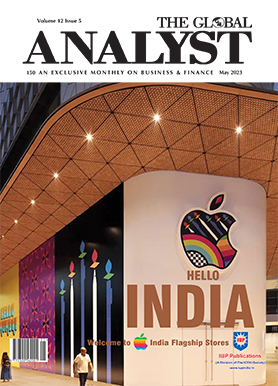
Hello India Welcome to Apple India Flagship Stores
The US consumer tech giant makes a big-bang foray into direct retail in India, the world's
second-largest smartphone market.
Indians' fascination for Apple has no parallels.
A fan waited in queue the whole night to lay
her hands on the iconic iPhone when it was
launched on August 28, 2008, a full year after
making its debut in June 2007 in the United
States. As recently as September last year, a man
from down south "traveled thousands of miles to
Dubai to buy the latest iPhone hours before it
went on sale in India". It was also on full display-
and expectedly so-as the American
consumer tech major opened the doors of the first
of its two retail outlets-its first ever flagship
stores to open in India where it entered 27 years
ago-that has come up in Mumbai's bustling
Bandra Kurla Complex (BKC)
financial, art, and entertainment
district.
BUSINESS ENVIRONMENT
Technology
Of the Layoffs, Causes and the Road Ahead
- By By Rob Enderle,President and Principal Analyst, The Enderle Group, Bend, Oregon, USA
I have several business degrees, many of which focus on manpower management, a now obsolete specialty that uses analysis to optimize workforce loyalty, satisfaction, and productivity. It became obsolete because the US government determined the practices were discriminatory. They favored well-trained employees at a time when schools favored majority populations over minority populations.
IN CONVERSATION WITH
Sailesh Jain
Fund Manager - Equities Tata Mutual Fund
trade like stocks and therefore offer
a degree of flexibility unavailable
with traditional mutual funds
Exchange Traded Funds (ETFs),
as a mutual fund category, have
just turned 30 this year. It was
three decades ago, or on January 22,
1993, to be precise, when the world's first
ETF-S&P 500 ETF Trust-hit the
market in the United States. Its overwhelming
success spawned similar
products in America and elsewhere. According
to Statista, an online platform
specializing in market and consumer
data, there were 8,754 ETFs globally in
2022, compared to 276 in 2003. Globally,
assets under management (AUM) in
ETFs, though, are only a fraction of the
total financial market. ETFs represent
12.7% of equity assets in the US, 7.8% in
Europe, and 4.1% in Asia-Pacific, shows
iShares data. In India too, awareness
about ETFs is slowly but surely increasing.
In an exclusive interview with Amit
Singh Sisodiya, Deputy Editor, The Global
ANALYST, Sailesh Jain, Fund Manager
- Equities, Tata Mutual Fund, talks
about the significance of ETFs as a mutual
fund category, their key features,
the advantages they enjoy over traditional
funds, the risks an investment in
these funds may entail, and his outlook
on the category.
FINANCIAL MARKETS
Indian IT Stocks
Still the Best!
Notwithstanding the current tough phase, the Indian IT industry appears to be well-placed to reap the benefits of
the upcoming global IT spending boom, estimated to be worth $4.6 tn, as well as new growth opportunities in
areas such as Cyber Security, AI, and the Metaverse.
- By M R Raghu, CFA, FRM, FCMA, CEO - MARMORE MENA Intelligence
Information Technology (IT) stocks
have been having bad days in the
stock market during the last year.
While the overall Nifty 50 index is up
1.3%, the Nifty IT index is down nearly
18% with steep losses noted for its star
constituents TCS (-11%), Infosys
(-24%), and Tech Mahindra (-21.5%),
with few exceptions like Persistent Systems
(up 7.2%). This has led to some
fundamental questions being asked
about the long-term outlook of Indian
IT stocks.
LEADERSHIP
Managing Business
Leadership Beliefs and Functional Suppositions
Effective leadership-and what makes an effective leader-is variable, and there is "no one-size-fits-all"
solution for all situations.
- By Michael Walton, Business Psychologist and Visiting Professor, UK
My supposition is that most, if
not all, people rely on a number
of implicit working principles,
guidelines, ideas, and notions to
help them make sense of what goes on
around them in the workplace. These
could be key learning points from past
experiences or perhaps influential
ideas and notions retained from their
training and workplace experiences.
The end result will be an idiosyncratic
collection of beliefs that will guide
executive action but remain private and
personal to each individual. To an observer,
an executive's unexpected,
counter-intuitive, or perhaps even bizarre
behavior could be the result of
that particular executive's personal set
of working principles being activated.
FINANCIAL SERVICES
Cyber Insurance
A New Kid on the Insurance Block
With cybercrime cases on the rise, more and more companies are making cyber insurance an essential
component of their comprehensive risk management strategy.
- By Surbhi Singhal, Senior Research Analyst, Advance ThinkTank, New Delhi
One of the biggest cyber attacks
in India was seen in the year
2022, when the country's premier
institution, the All India Institute
of Medical Sciences, or AIIMS as it is
popularly known, was hit by a
ransomware attack. The AIIMS server
went offline for about two weeks before
the authorities recovered the data and
the systems went online.
CURRENCY MARKETS
Japan
What Does a Stronger Yen Mean?
Due to its extraordinarily low rates, Japan has been a significant exporter of capital to international markets.
However, if domestic yields climb, capital is anticipated to move from the rest of the world to Japan, which will
weaken other currencies and strengthen the JPY and in turn, cause foreign debt yields to increase.
- By Shail Apte, Founder & CEO, Airtham, Ahmedabad
Unlike last year, when the yen
lost ground to the US dollar
(USD) at an unprecedented
rate, the Japanese unit has gained
ground in 2023. This could have wider
ramifications for international markets.
Take a look at the data: The Japanese
Yen (JPY) strengthened from 150
JPY/USD in October 2022 to 134 JPY/
USD currently (as of April 24, 2023),
mostly due to a weaker USD and the
widening of the Yield Curve Control
(YCC) policy target rate window by the
Bank of Japan (BOJ), the country's central
bank.
POLICY
Indian Gas IndustryEnter the New Pricing Mechanism
Domestic gas customers are expected to greatly profit from the introduction of the new pricing mechanism as prices
are anticipated to drop.
- By Rajat Kapoor,Managing Director, Synergy Consulting, Inc., New Delhi
The gas industry in India has undergone
significant growth in recent
years, with increasing demand
for natural gas across various
sectors such as power generation, fertilizers,
and city gas distribution. The industry
has also played a vital role in
reducing India's dependence on imported
fossil fuels and diversifying its
energy mix. It is estimated that India
consumed nearly 64 BCM natural gas
in FY 2021-22, of which nearly 45% was
met from imported liquified petroleum
gas (LNG) thus making it the 4th-largest
importer of LNG. Gas usage in the
country has been growing exponentially
thanks to a huge population, a burgeoning
middle class, and rising domestic
economic activity.
Q&A
Forward-Thinkers' Talks
A Conversation with Maurizio Zordan
In this first part of the "Forward Thinkers' Talks Series," conducted by Ivo Pezzuto, Professor of Global Economics and Digital and Sustainable Innovation at ISM Paris/New York and Founder of the Ivo Pezzuto Forward- Thinking Lab, he interviews Maurizio Zordan, Zordan srl sb's CEO, and Woodways' President.
MACRO MONITOR
Cheap Oil
India, along with China, has emerged as the saviour for Russian crude following Moscow's invasion of Ukraine and the Western sanctions imposed in its wake. In fact, more and more Asian buyers are trying to benefit from the cheaper Russian oil even as European and other Western buyers stay away.