|
COVER
STORY
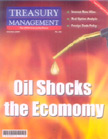
Oil
Shocks the Economy
-- K Seethapathi and T Jyotsna
In
India, the imports of crude oil is nearly three-fourth of
its requirement. So it is crystal clear that any small increase
in the world crude oil price will have great impact on domestic
economy. The changes in the world crude oil price have increased
the inflation rate in the economy and as a result, it has
affected the stock markets also. The article tries to shed
light on some of the reasons for such an increase and its
implication on Indian economy and domestic sector.
© 2004 IUP. All Rights Reserved.
COVER
STORY
Oil
Shock
-- Sathya Kumar Reddy
The
increase in oil prices has once again demonstrated the vulnerability
of the global economy. Excess dependency on oil will certainly
affect the global economies, particularly that of the poor
and developing global economies. India's position is similar,
considering the present and future demand for oil. Can the
world manage a viable and sustainable source of energy for
its future needs?
© 2004 IUP. All Rights Reserved.
COVER
STORY
Crude
Oil Prices:is there an Upper Limit?
-- KL Narasimha Rao
In
the present economic scenario, one of the important factors
that determine the economic development of a country is the
change in oil prices. The recent increase in oil prices can
be attributed to the result of the relationship between demand,
supply, and other speculative factors. The strong recovery
of US economy and the rapid growth in Asia also increased
the demand for oil and contributed to the surging oil prices.
In this scenario, the article tries to determine the reasons
for the mounting global oil prices.
© 2004 IUP. All Rights Reserved.
TREASURY
Hike
in Interest Rates - Wave of Optimism?
-- G Alivelu
Federal
Reserve Chairman, Alan Greenspan indicated the escalation
of interest rates in April 2004, considering the contemporary
economic data, which is good for the economy but bad for the
bond market. Inflation and resurgence in US employment are
considered as the two key players that prompted the Fed to
increase interest rates from the current four-decade low.
Against this backdrop, investors are maintaining restraint
on the eve of interest rate increase.
© 2004 IUP. All Rights Reserved.
TREASURY
Asian
Common Currency: Can This Dream be a Reality?
-- Jaya Gupta
As
globalization deepens its roots across the world, the importance
of small countries' currencies is diminishing in economic
terms, thus paving the way for a common currency regime. After
the launch of euro, the Asian economies are now debating over
the feasibility of common currency for their region. It is
expected that the emergence of this common currency will reduce
transaction costs across the Asian frontiers and play a major
role in formal trade, which in turn would earn valuable revenue
for the government.
© 2004 IUP. All Rights Reserved.
RISK
Measuring
Flexibility Through Real Option Analysis
-- Dibyendu Dutta
Real
option analysis is the tool used in the measurement of investment
decisions and for strategic planning under uncertainty. Real
option is one among the important measuring criteria used
by the corporates for valuing investment opportunities. It
presents a quantitative method for monitoring, measuring,
and adjusting decisions according to the economic changes.
It helps the management to analyze flexibility of projects.
The article analyses the advantages of real option analysis
for business decision-making in the dynamically changing business
environment.
© 2004 IUP. All Rights Reserved.
RISK
The
Novel Option: LEAPS
-- Vinay Mahajan
The
lure of investment is far from over for investors. The story
of options and option strategies are yet to take a formal
shape and here comes an option that opens a new sphere of
investment stratagem. LEAPS Long-term Equity Anticipation Securities
are providing investors with a wide range of investment alternatives
and opportunities to make investments for a longer term. So
a lesser amount is at risk for a longer time to benefit from
appreciation in the price of the underlying.
© 2004 IUP. All Rights Reserved.
FOREX
India's
Foreign Trade Policy: 2004-2009
-- Sanjeev Kumar
The
recently announced first Foreign Trade Policy of India indicates
a major shift in the government's opinion about the conduct
of external trade. The magnitude of changes seen in the new
trade policy displays a wider aspect of liberalization of
export. The target of doubling India's export by 2009 and
the steps taken to achieve this target are appreciable but
at the same time appear doubtful in the current situation.
This article looks into the issue.
© 2004 IUP. All Rights Reserved.
|