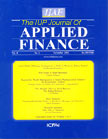
|
Stock
Market Returns and Inflation: An Analysis of the Direction
of Causality
-- Bharat Kolluri
Common
stock investment holds a central place in the lives of millions
of individuals in the United States, either directly or indirectly
through their personal investment and/or retirement plans.
Current literature suggests that investors cannot use common
stock investment as a protection against rising prices or
inflation. This contradicts the traditional view and economic
theory that all real financial assets, including common stocks,
are positively related to inflation. Many of the previous
studies focused on the interpretation of the puzzling negative
relationship while ignoring the basic issue of causality.
An attempt is made in this paper to identify the causal influence
of inflation on stock returns and a reverse causality from
stock returns to inflation. The results indicate bidirectional
causality between these two variables.
©
2005 IUP. All Rights Reserved.
Foreign
Capital Financing of Indian Corporate Sector: Trends and Determinants
during the Period of Liberalization
--
Jitendra Mahakud and L M Bhole
This
paper analyzes the trends and determinants of foreign capital
financing and estimates panel data models. More specifically,
it looks into the fixed effect firm and time models by using
data for 787 companies for the period 1992-93 to 2003-04,
for empirically identifying the factors which affect the demand
for foreign capital of the private corporate sector in India.
The paper finds that there is an increasing trend in foreign
capital financing in India; and size of the firm, liquidity
and market risk are the major determinants of the demand for
foreign capital of the Indian corporate sector.
©
2005 IUP. All Rights Reserved.
Modeling
Dalal Street Using Genetically Engineered Neural Network
-- Subramanian S and U S Rao
The
forecasting of Stock Indices using various models is a highly
recurrent, as well as difficult, theme in Finance and Investment.
The payoff in profitability from a small increase in predictability
in stock markets is enormous. Traditionally, the problem has
been tackled by econometric models. However the `normality'
and `linearity' assumption in these econometric models is
questionable as revealed by empirical studies. In recent times,
non-linear approaches have shown good promise in financial
forecasting. Artificial Neural Networks are able to outperform
most linear methods, however, their design and choice of various
parameters is a `difficult art'. One alternative to this problem
is the utilization of a Genetic Algorithm to determine these
decisions so as to discover the `best' Neural Network. In
this paper, this hybrid Artificial Intelligence method for
Sensex prediction is used. The `Naturally Evolved Network'
shows very good accuracy in both training as well as test
periods, outperforming other models.
©
2005 IUP. All Rights Reserved.
Capital
Structure of Indian Private Corporate Sector: An Empirical
Analysis
-- Sudhansu Mohan Sahoo
and G Omkarnath
The
question of corporate capital structure has long attracted
the interest of researchers and institutions in developed
countries and there are clear links between these issues and
debates over the kinds of financial markets and institutions
that are supportive for long-term growth of corporate sector.
The main purpose of the present paper is to analyze the capital
structure of the Indian corporate sector. It also examines
whether any shift has taken place in the financing pattern
of the Indian corporate sector after the implementation of
financial liberalization in early 1990s. Finally, the study
discusses all those different factors that determine the debt-equity
choice of Indian private sector firms. While addressing the
above- mentioned issues, help of the method of ordinary least
square has been taken, to empirically analyze the given objective.
The Indian context presented a totally different result, as
compared to the findings of literature in the developed countries,
on capital structure.
©
2005 IUP. All Rights Reserved.
Investment
Preferences of Retail Equity Investor: An Empirical Study
-- B S Bodla and M S Turan
This
paper aims to determine whether retail investors' perception
about risk of a security is consistent with the perceived
return concerning that security. The study is based on primary
data, which have been collected through a well-designed questionnaire.
The respondents were asked to rank as many as 11 investment
vehicles by risk and return on a 5-point scale. A test for
paired differences has been employed to test the validity
of the null hypothesis (H0) so that the risk ranking
proposed by each respondent will approximate the average return
ranking for each instrument/asset class. The results indicate
that retail investors do not rank a high majority of the alternative
investment vehicles at the same risk and return levels. The
study, thus, provides some additional evidence that retail
investors do not always follow theoretical assertions.
©
2005 IUP. All Rights Reserved. |