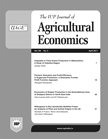
Structural Changes in Commodity Composition and Direction
of Agricultural Exports in India Under WTO Regime
-- Priyanka Mahajan and Paramjit Nanda
The paper examines the impact of opening up of agricultural sector on the commodity composition and structural changes in agricultural and allied products’ exports and direction of agricultural exports of India during post- WTO period (i.e., 1995-96 to 2005-06). The study reveals that though India’s agricultural exports share in world’s agricultural exports witnessed a fluctuating and declining phenomena after 1996, the share of India’s agricultural exports in world total agricultural exports is greater than the share of India’s total exports in world’s total exports. Within agricultural and allied products, if we consider the share of India’s agricultural exports to world exports, there has been a sharp turnaround, contributed mainly by the enhanced share of exports of rice, tea and mate and spices. Commodity-wise analysis of comparative advantage shows that over the period, India has lost its comparative advantage in all of the agricultural commodities, except vegetables and fruits, sugar and sugar preparations. This loss of comparative advantage of India’s agricultural exports in world market is the result of imposition of various health and phytosanitary measures, environment and labor standards on country’s exports. To meet the challenges of the Indian economy, the Agreement on Agriculture (AOA) has to be viewed in an integrated manner along with other agreements, viz., Agreement on Sanitary and Phytosanitary conditions, Agreement on TRIPS, Agreement on TRIMS and Agreement on Dispute Settlement (World Bank, 2002). Further, easy export licensing and technical know-how regarding production, processing and marketing of exportable goods should be provided by the government.
© 2011 IUP. All Rights Reserved.
Attitude of Farmers Toward Agriculture Insurance:
A Study with Special Reference
to Ambasamudram Area of Tamil Nadu
-- R Malini
Agricultural insurance is indispensable for the prosperity of farmers and policy
instruments to deal with the perils present in agriculture. But the implementation
of agriculture insurance largely depends on the farmers’ attitude. This
study assesses and tests the attitude of respondents toward agriculture
insurance, and favorable factors and problems prevailing in implementing
agriculture insurance. Sixty farmers were interviewed between April 2008 and
August 2008. The farmers were selected by adopting convenient random
sampling method. The collected data were analyzed with the help of percentage
analysis and sign test. The study reveals that the farmers have good attitude
toward agriculture insurance. Besides, they accept that certain favorable
factors and stumbling blocks are prevalent in implementing agriculture
insurance in Ambasamudram area. On the basis of the findings, the study
suggests certain mechanism to boost up the share of agricultural income of
Ambasamudram area at all levels.
© 2011 IUP. All Rights Reserved.
A Study of Microfinance as an Innovative Credit Delivery
Mechanism in Rural India
-- K K Tripathy and Sudhir K Jain
The key problem of Indian agriculture is finance. Several weaknesses of the
rural financial delivery system, have not been corrected even after almost 40
years of bank nationalization of 1969 which focused on enhancing the
outreach and access to rural credit in India. In addition to reviewing
agricultural credit policies followed in India and assessing the trends and
progress in the credit flow and access, this paper aims at examining the
suitability of government-directed microfinance activities as an alternate tool
to the formal credit delivery mechanism in rural areas. Drawing upon the field
surveys conducted in four districts of two federal states in India, the paper not
only indicates the wide recognition the program has gained within the rural
community but also reflects the inequitable impact of microfinance initiative,
and highlights a few prominent flaws in program implementation and
administrative mismanagement which reduce the effectiveness of the program.
While the survey findings reveal the main problem areas like unfriendly attitude
of bank officials, inaccessible bank branches, non-availability of timely and
adequate credit, sub-optimal selection of key economic activities and marketrelated
problems, the regression result points out that land-based activities are
not remunerative for the microfinance beneficiaries. This analysis also
indicates that literacy, interest rate on loanable funds, ownership of productive
assets and savings are the major determinants of the income function. The
paper concludes with some policy implications for improving the design for
implementing the program. The paper adds to the extant knowledge about
microfinance programs by comparing the performance of formal banking with
the informal banking through microfinance initiatives in a developing country
like India.
© 2011 IUP. All Rights Reserved.