| COVER
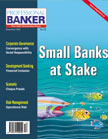
STORY Small
Banks at Stake
- - Katuri Nageswara Rao
This
article speaks about the gradual extinction of small banks like Nedungadi Bank,
Global Trust Bank (GTB), Bank of Madura, Bharath Overseas Bank, etc., for various
reasons. It then analyzes the recent takeover by Industrial Development Bank of
India (IDBI) of United Western Bank (UWB).
© 2006 IUP . All Rights Reserved
CORPORATE
GOVERNANCE Convergence
of Corporate Governance with Social Responsibility in Banks
- - BK Swain Banks,
as funding organizations and advisors with the requisite expertise, have a comparative
advantage to promote socially and environmentally sustainable business that will
decide the development and direction of the economy.
© 2006 IUP . All Rights Reserved
STRATEGY
Strategy
for Bank Branches : The TOWS Matrix
- - A Lakshminarasimha, S Murali This
article provides an overview of SWOT analysis and leads on to TOWS matrix. The
TOWS matrix matches strengths and weaknesses to the opportunities and threats
that the branch faces and helps develop strategies for the branch. A format is
developed which can be directly applied.
© 2006 IUP . All Rights Reserved
STRATEGY
Innovative
Strategies to Finance SMEs
- - SN Ghosal Small
and Medium Enterprises (SMEs) play an important role in the economic development
as the second largest employment providers, but they suffer due to high cost of
funding. This article discusses innovative strategies to finance SMEs effectively.
© 2006 IUP . All Rights Reserved
DEVELOPMENT
BANKING Relief
Measures by Banks in Areas Affected by Natural Calamities
- - Reena Ray The
banking community should come forward on its own and play a developmental role
in times of natural calamities. Throughout the year, people in one geographic
part or the other, face one or more natural calamities due to floods, drought,
perennial rains, earthquakes, cyclones, storms, etc. The end result is heavy toll
on lives, and resources. Sometimes the intensity and reach of devastation caused
by such natural calamities is so high that even watching them on the television
sets at home makes us shiver.
© 2006 IUP . All Rights Reserved
DEVELOPMENT
BANKING Financial
Inclusion : Taking Banking to the Masses
- - D Satish
There
is still a vast majority of the Indian population that is unbanked. To reach this
population, which has so far been excluded by the banking sector, the Reserve
Bank of India has proposed some measures and is also stressing the importance
of greater financial inclusion. The Indian banking sector has witnessed tremendous
growth in the past 15 years with the intensified competition among public, private
and foreign banks.
© 2006 IUP . All Rights Reserved
SCENARIO
Cheque
Frauds in Indian Banks
- - Madan Lal Bhasin
The
unflagging popularity of paper cheques coupled with the ready availability of
latest printing technology has resulted in an alarming increase in cheque frauds
in Indian banks. This article analyzes various ways to curb this menace.
© 2006 IUP . All Rights Reserved
INTERNATIONAL
BANKING Indonesian
Banking : Strengthening through Consolidation
- - Krishna Kishore Puranam During
the Asian financial crisis, the entire banking system of Indonesia collapsed;
however, since then the progress is astonishing. The Indonesian government has
successfully privatized several banks and now is framing policies to further strengthen
the sector through consolidation. Indonesia is one of the largest countries in
Asia with the population of 230 million. However, among members of the Association
of South-East Asian Nations (ASEAN), the country has lower per capita income and
had the lowest real GDP growth rate. It's not surprising that its financial sector
is one of the costliest in the world with more than 50% of GDP was spent to bail
out the banking sector in the aftermath of the Asian crisis in 1997-98.
© 2006 IUP . All Rights Reserved
RISK
MANAGEMENT Why
Much Ado about Operational Risk?
- - RH Sharma
Thanks
to Basel II norms, operational risk management has become a very important function
for banks. Risk-taking is a characteristic that inculcated into human nature.
The child takes the risk of falling down and injuring himself for a tradeoff of
learning to walk. In the primitive age, man grew up weighing up the risks of attacking
others against the reward of acquisitions. In later stages, he invested in the
planting of crops for the reward of the harvest, and offerd sacrificess to the
gods in expectation of reward in the afterlife.
© 2006 IUP . All Rights Reserved
RISK
MANAGEMENT Risk
Management and Basel II
- - Meenaxi Dhariwal, Sapna Goel
The article argues that the compliance with Basel II norms can put banks in
a better position to manage credit risk, market risk and operational risk. The
statement holds true, as banks are facing high risks, primarily because banking
is one of the most highly leveraged sectors of any economy. To overcome the risk
and to make banking function well, there is a need to manage all kinds of risks
associated with the banking. Thus, risk management becomes one of the main functions
of any banking service - it is core to any banking service. The ability to gauge
risk and take appropriate action is a key to success for any bank.
© 2006 IUP . All Rights Reserved
FOCUS
The
US Housing Bubble and Global Recession
- - Yash Paul Pahuja
Economists
and s in the US are predicting that housing prices will start falling during
the end of 2006 or early 2007. Facts are also supporting the predictions of these
economists. According to the National Association of Realtors (NAR), median US
home prices grew by 10% during the first quarter of 2006 and less than 4% during
the second quarter of 2006 compared to the same period in the previous year respectively.
© 2006 IUP . All Rights Reserved |