April'23
The IUP Journal of Organizational Behavior
Archives
Analysis of Gender Representation in Bengali Print Advertising During the Pandemic in Work from Home Situations
Amrita Basu Roy Chowdhury
* State Aided College Teacher, Department of Women's Studies, Lady Brabourne College, Kolkata, West Bengal, India. E-mail: basuroyamrita1983@gmail.com
br>
Construction of gender roles in advertisement has been a critical area of discussion and examination. Being an inextricable content of media advertisements reflect and underpin gendered notions about what it means to be a woman or a man and how they should behave in society. During the Covid-19 pandemic too, the advertising industry, responded well to reflect these new challenges and trends in their communication. However, the advertising world failed to lay emphasis on the leadership trait of women. This paper intends to capture the gender representation in WFH situations due to the pandemic in Bengali print advertisements. It also attempts to trace whether the ads were able to portray the consequences, issues, and challenges women faced during the period. The paper seeks to achieve these objectives by focusing on the product advertisements published between March 2020 and March 2022 in Anandabazar Patrika, Ei Samay and Pratidin-the three leading Bengali dailies. The study employs a descriptive qualitative content analysis.
Introduction
The Covid-19 pandemic resulted in business disruption as well as unforeseen losses of human lives. All the efforts across the globe were directed towards tackling the situation, which seemed both uncertain and unending. The impact has been felt by all the employees and organizations alike. However, surveys (McKinsey, 2021) and experience reveal that women are affected more than men by the social and economic effects of infectious diseases due to the additional role of caregiver due to educational institutions remaining closed, unavailability of domestic help and ailments of family members during different waves of the pandemic. Women underwent a threefold burden since they were responsible for prevention of disease, vulnerable to infection, and also subject to emotional, physical and socioeconomic crisis. For a working woman, the burden turned out to be fourfold. The pandemic has redefined work and brought an intense change in the way work has been done by both men and women. With the prolonged pandemic and remote work, the kitchen platforms were transformed into home offices for women across the globe, blurring the line between work and home. Working women were feeling overstrained by a higher share of domestic chores and responsibilities with the WFH strategies enforced by different enterprises. Additionally, while both the partners have been working from home, women in India seem to handle a major portion of domestic duties. Sharada (2021) argues, "Definitely, we do not want to bear the extra burden of being multi-taskers and superwomen. Let work-life balance be equally relevant for men."
Gender and Media
Construction of gender roles in the media and advertisements has been a topic of serious debate and investigation. Advertisement being an inseparable content of media shapes and reinforces gendered notions about what it means to be a woman or a man and how women and men should perform in a society. During the pandemic situation too, the advertising industry, according to Sharada (2021), "responded well to reflect these new challenges and trends in their communication while trying to sell products and services as best as they could." However, she feels that the advertising world must lay emphasis on the leadership trait of women. Although the WFH scenario was used as the background for some advertisements during pandemic situation, "...we need more such visibility of working women, leaders, achievers and role models in our communication to counter the deep-rooted under-valuing of women and girls in our society" (Sharada, 2021). Advertisement has the power to strengthen the voices of women, demonstrate their dynamic roles during the pandemic and also question the gender stereotypes. Presence of women in advertisement certainly does not uphold gender-neutral attitude and, therefore, it is imperative to study the advertisement industry in order to substantiate whether the pandemic issues were exhaustively addressed from gender angle or solely discounted.
Objective
The paper intends to capture both 'work for home' and 'work from home' situations from a gender perspective in Bengali print advertisements published during the pandemic period. It also attempts to examine whether the advertisements have been able to portray the consequences, issues, and challenges women faced in a WFH situation.
Methodology
The paper focuses on the advertisements published between March 2020 and March 2022 in Anandabazar Patrika, Ei Samay and Sangbad Pratidin-the three leading Bengali dailies in terms of circulation all through the year. The advertisements on FMCGs/non-durable goods, durable goods and also service products are included in the study. According to Stokes and Wendy (2008, p. 217), products can be classified according to their tangibility, durability and also end-use. According to tangibility, products can be divided into two categories-tangible products and intangible products or service products. Tangible products are further sub-divided based on their durability-non-durable product or Fast-Moving Consumer Goods (FMCG) and durable products. Non-durable products are consumed relatively rapidly and usually reordered regularly. Therefore, we can see that product advertisement covers a vast area which includes FMCG or non-durable goods (for example, beauty products, food and beverage, toiletry, health-related products and so on), durable goods (for example, furniture, clothing, electrical and electronic goods and so on) and also service products (hospitality products, financial products which include insurance, credit/debit cards, loans and so on). This paper is restricted to three broad categories: FMCG/Non-durable products, durable products and service products.
A descriptive qualitative content analysis was developed based on the nature of investigation (Krippendorff, 2004).
Theoretical Perspectives
Merriam Webster Dictionary defines 'construction' as "the way something is built or made" or "a way of understanding something". Construction also refers to the social construction of gender roles. Boghossian (2001, p. 6) defines social construction thus:
To say of something that it is socially constructed is to emphasize its dependence on contingent aspects of our social selves. It is to say: This thing could not have existed had we not built it; and we need not have built it at all, at least not in its present form. Had we been a different kind of society, had we had different needs, values, or interests, we might well have built a different kind of thing, or built this one differently. The inevitable contrast is with a naturally existing object, something that exists independently of us and which we did not have a hand in shaping.
Boghossian (2001, p. 7) mentions that Ian Hacking, in his monograph, The Social Construction of What? (1999) precisely notes that social construction concept is often applied not only to mundane items like things, kinds and facts but also to our credence to them. Feminist scholars (Beauvoir, 1949) have highlighted the notion that gender roles are not natural or predestined but are the construction of social forces.
Gender role, in this study, refers to the role portrayed by a character in an advertisement. The character could be either a man, a woman or a group. Gender role is an outcome of the patriarchal society's expectations of a character based on his/her gender and the behavioral aspects associated with that gender within a social structure or environment. According to Blackstone (2003, p. 335),
Gender roles are based on the different expectations that individuals, groups, and societies have of individuals based on their sex and based on each society's values and beliefs about gender. Gender roles are the product of the interactions between individuals and their environments, and they give individuals cues about what sort of behavior is believed to be appropriate for what sex. Appropriate gender roles are defined according to a society's beliefs about differences between the sexes.
The gender roles portrayed by the central character in the advertisements have been classified into the following four categories-decorative role, working role, family role and freewheeler (Courtney and Lockeretz, 1971; McArthur and Resko, 1975; Goffman, 1979; Dwivedy et al., 2009; and Das, 2010). The roles portrayed by the central character may not be mutually exclusive and a character may display multiple roles within the same advertisement. In such cases, the most dominant of the roles portrayed by the central character has been taken as the gender role. For the purpose of analyzing the advertisements where the central character is either a single woman against a supporting character of single man or a single man in a central character against a supporting character of a single woman, theoretically three parameters have been taken into account-relative size, function ranking and ritualization of subordination.
"When both man and woman are present, the man is taller and/or bigger than the woman and takes up more space in the picture" (Lindner, 2004, p. 413). More often than not, a man tends to occupy a larger space in the advertisements by virtue of his height and size. These larger physical attributes of a man in the advertisements seem to
re-establish the superior platform of social construct on which he is placed compared to a woman. Even in advertisements where a man and a woman may not be related, advertisements tend to follow these dimensions. The natural corollary that evolves has been well captured by Goffman (1979, p. 28), who noted, "very nearly every couple will exhibit a height difference in the expected direction". This investigation proposes to investigate this phenomenon of relative size and the character(s) is/are classified on the basis of his/her/their position/s within the ambit-larger, smaller and equal.
Further, when both man and woman are present, the man serves as the instructor or performs an executive role (Lindner, 2004, p. 414). According to Goffman (1979,
p. 32), in our society, when a man and a woman collaborate face-to-face in an undertaking, the man is likely to perform the executive role. This arrangement seems widely represented in advertisements, in part, no doubt, to facilitate interpretability at a glance. The advertisements have been classified on the basis of function ranking as defined by Goffman. They are executive, supportive and equal. It is also true that woman lowers herself physically in some form or other of prostration; canting postures are associated with acceptance of subordination. This includes lying or sitting on the ground, bed, or sofa-whether in the presence of another person or not-canting of the head or entire body. Also included in this category is a woman being embraced by a man, who inhibits her movement, or a woman leaning against a man's shoulder or holding on to his arm for support, dependent on and subordinate to the man present (Lindner, 2004, p. 414).
Postures of the characters have typically been a made of stereotyping in advertisements. Advertisements often show a woman leaning against the shoulder of a man, holding or interlocking his arm, bent shoulders with head resting upon a man, etc. These types of postures of a woman tend to associate her with the notion of subjugation or subordination to a man. The man, on the other hand, is often shown as holding a woman caringly or protectively when he wraps his arms around her. A man is also portrayed with his head held high. These types of postures of a man provide him with an air of superiority over the woman. More often than not, a woman is portrayed in a subordinated position compared to a man. "A classic stereotype of deference is that of lowering oneself physically in some form or other of prostration. Correspondingly, holding the body erect and the head high is stereotypically a mark of un-ashamedness, superiority and disdain" (Goffman, 1979, p. 40). The paper proposes to investigate this phenomenon of ritual of subordination and the character(s) is/are classified on the basis of his/her/their position/s within this ambit as superior and subordinate.
Advertisement and Construction of Gender Roles
According to Aldous Huxley, advertisement is one of the most interesting and difficult modern literary forms. It is not surprising that advertisement as a modern literary form has a key role in the ideological construction and transformation of the public discourse. In Goffman's (1979) terms, advertising serves to define or frame reality and thus the social impact of advertising cannot be overlooked. Construction of gender roles in advertisement has been a serious area of discussion and examination until the present. Advertisement being an inextricable content of media outlines and underpins gendered notions about what it means to be a woman or a man and how women and men should behave in a society. In Ogilvy on Advertising, Ogilvy (1985) writes about some major aspects of advertisements. He states that advertisements are more of a medium of information rather than a source of entertainment or creativity. Advertising attempts to put forth an image of ideals for the society. The ideals they portray do not necessarily reflect society but may influence people's beliefs about the world outside of their immediate environment. Chaudhuri (2001) in her essay, illuminates us with her analysis of advertisements and gender images in the English print media in India. Her study reveals that "although some images of Indian women are traditional (the homemaker and mother), many are new (the globetrotting corporate leader), and suggest a break with earlier models" (p. 373). She also validates that there is an attempt to consolidate the positive notions of individual "achievement, pleasure, and identity for both men and women" (p. 373). Cultural theorist Williams (1980) presents a similar explanation and considers advertisements to comprise a 'magic system.' Williams (1980) explains that advertising is a magic system which has two forms; one is the cultural form and the other, economic form. As he talks about the cultural form, he mentions that it can be seen as 'a system of fantasy'. The product surpasses its materialistic value, since it sells the idea of what that person will be when he or she buys that product. The economic form highlights the notion of 'capital'. While referring to the impact of advertisement on society, Pollay (1986) compares advertising to 'brain surgery'. While the metaphor of brain surgery may be hyperbole, the inflated rhetoric so characteristic of advertising, still contains an element of truth. Advertising is without doubt a formative influence within our culture, even though we do not yet know its exact effects (p. 896). Advertising intervenes everywhere, from street to home, from office to gym breaking the divide of public/private. As mentioned by Pollay (1986), advertisements bestow a set of conditions which tend to idealize certain situations of life. Within the space of contemporary advertisement, gender is probably the most used social resource.
An Illustration of Gender Roles in Post-Pandemic Bengali Print Advertisement
This section aims to use qualitative content analysis as a method of investigation to elucidate how gender roles are being constructed in Bengali print advertisements published in Anandabazar Patrika, Ei Samay and Pratidin between March 2020 and March 2022.
Fifty-three Bengali print advertisements published during the pandemic have been considered for the study. The study exposes how different brands lean towards depicting gender roles by means of stereotypical approach in these advertisements. In most of the advertisements, men appear as the breadwinners of the family and women as the caregivers, home managers. The kitchen is still a woman's domain and keeping the house hygienic and disinfected seems to be one of the primary duties of women during the pandemic. Compared to men, working women are hardly portrayed in these advertisements. There are some exceptions where we find women in empowering roles, although the number is too less to come to the conclusion that there is a positive change. The following section aims to meticulously and critically evaluate some of the advertisements to decipher the dominant gender roles played by both men and women during the Covid-19 pandemic.
Gendering 'Work for Home'
GoPure anti-bacterial hand sanitizer purifies and protects from unwanted germs. The Ayurvedic formula kills 99.9% of bacteria and protects the family against enveloped viruses. The sanitizer with moisturizer keeps the palms soft and germ-free. The conventional demonstration is very much evident in the advertisement as 'softness' or 'tenderness' is represented through the mother-daughter duo (Figure 1). The mother seems to be in a playful and jovial mood offering her daughter a piece of cake. Although GoPure hand sanitizer is an alcohol-based (70% isopropyl alcohol) gel proven to kill 99.9% of micro-organisms like bacteria, viruses, protozoa and fungi from hands and protect the users from infections, it underscores the incomparable quality of the natural, Ayurvedic ingredients like neem (azadirachta indica), aloe vera and turmeric as conveyed through its tagline. The traditional role of Indian mother gets highlighted through the existence of traditional ingredients in the hand sanitizer itself. Building up the child's future and taking care of the family have been her exclusive responsibilities. The mother
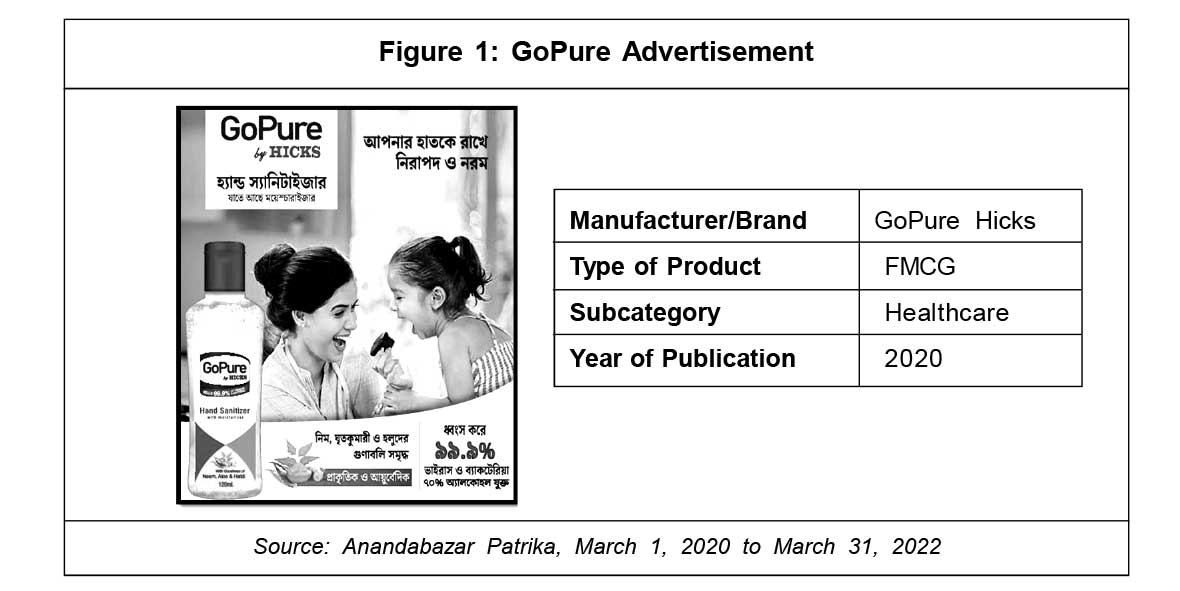
simultaneously plays a decorative role in the advertisement. Another concern is the mandatory presence of the girl child whenever it is the issue of 'softness of the skin'. The onset of the pandemic did not change this representation as evident from the GoPure advertisement published in Anandabazar Patrika on August 21, 2020.
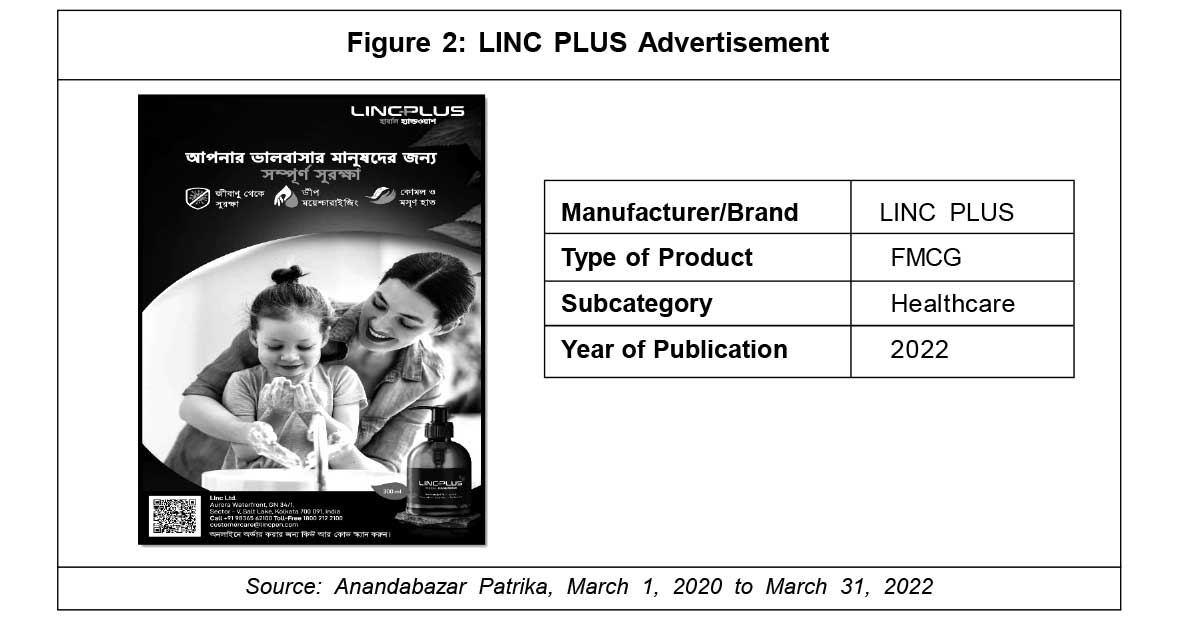
The advertisement for LINC PLUS was published in Ei Samay on January 19, 2022. This advertisement again reflects the concern of a mother for her daughter to remain hygienic by using this particular hand wash. The caption written in Bengali can be translated as "For your loved ones LINC PLUS brings complete protection by disinfecting, moisturizing the palms and also making them smooth and soft." Again, the notion of 'softness' is attributed to a girl child. An Indian mother is the central figure in household matters. Her habits considerably influence all traits of a child's life, whether it is about behavior, education or health. A mother is always responsible for upholding the cleanliness and health of her child. Here we not only perceive the girl child cleaning her hands but also the mother simultaneously washing her own hands to train her daughter how to clean hands properly. Both the mother and the daughter appear in a non-traditional attire although the mother performs her traditional duty, that is, looking after her child. Even though the color 'blue' is associated with typical masculinity, in this advertisement the mother is wearing a blue-colored jeans jacket, which suggests a sense of dependability, constancy, and dedication towards her family.
LINC PLUS is a skin-friendly, antimicrobial herbal oil enriched with aloe vera and tea tree oil which again stresses the traditional role of an Indian mother in promoting the benefits of Ayurveda (Figure 2). Although the mother seems to be engaged in familial activities, she plays the role of a beauty stereotype which is again a very cliched portrayal of a woman for product promotion. This advertisement reinforces discriminatory gender roles, implying that house work and taking care are women's primary responsibilities.
The advertisement for Sanofi Pasteur (Figure 3) was published in Anandabazar Patrika on November 29, 2020. This advertisement expresses the importance of vaccinating a child to protect him from brain-related fever and other diseases. It is evident from the advertisement that the mother and her baby boy are playing together within the four-walled room. Spending adequate time with children seems be the responsibility of a traditional Indian mother, although in terms of attire she breaks the norm by wearing two piece and hence connoting a sense of a "mother of modern times". This contradictory representation of a woman reminds us of an idiomatic expression-"Old wine in a new bottle." The carpet, the furniture, the attire of both mother and son are designed in white, conveying a sense

of chastity and purity. Hygiene is related to better reproduction of family ideals and values, and pivots on the chaste, clean and hygienic figure of the woman, which raises the question: When both the parents are at home, why is it that the mother has to always play with the child! Additionally, with regard to vaccination, why is that the mother alone should always be worried? What about the father?
In the previous advertisement, we visualized the presence of a girl child for a product which not only disinfects but also makes her skin soft. Vaccination is a serious matter for children irrespective of gender, but the narrative of the Sanofi Pasteur advertisement seems to reinforce the urgent requirement of vaccination for the male child, which again underscores the gender discrimination prevalent in our society.
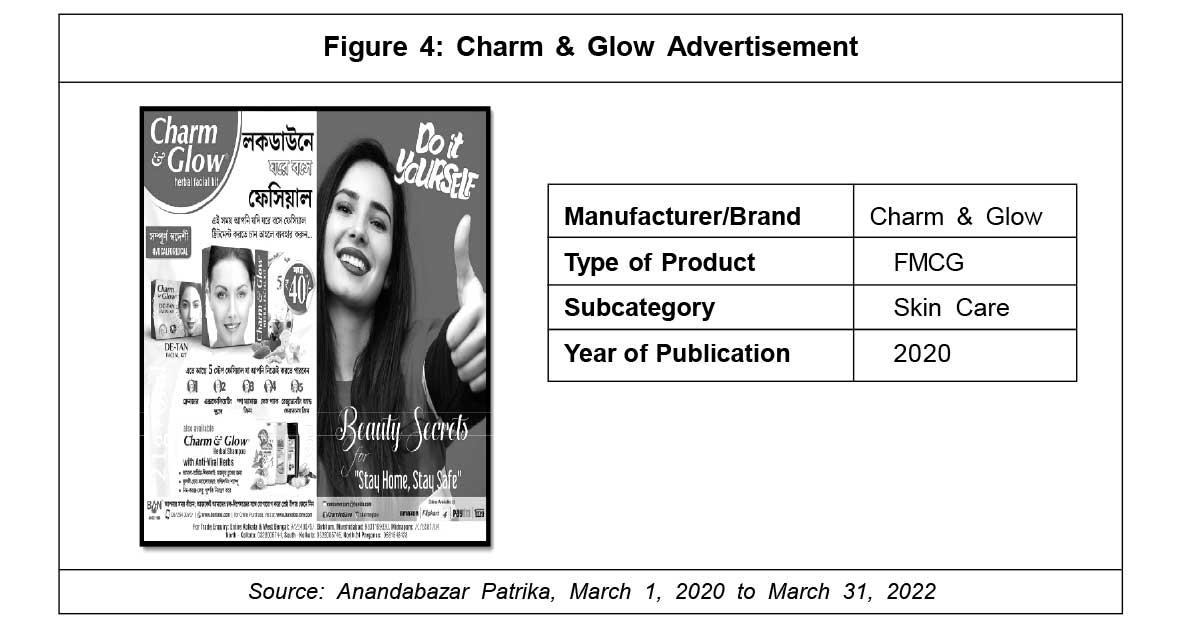
The advertisement for Charm & Glow (Figure 4) was published on May 30, 2020 in Anandabazar Patrika. This advertisement was often published during the first phase of lockdown in India. For healthy and glowing skin, a woman must use Charm & Glow herbal facial kit at home during the lockdown. Regular use of this herbal product will make the skin smooth, shiny and squishy. The advertisement apparently seems to resist racist attitude by replacing the word 'Fair' with 'Glow'. There is a clear message in the advertisement about staying home and staying safe, which is, however, contradicted by the use of the tag line-the 'de-tan' facial kit. How can our skin be tanned unless we go out in the sun? Perhaps the assumption comes from the notion that women are excessively involved in culinary activities and other domestic chores. Therefore, due to lack of adequate sleep and rest, the skin might look dull and darkish. At this point, the only product that can bring back the glow of the skin is the Charm & Glow facial kit. The woman in this ad appears in a decorative role flagging the constant need for looking beautiful even during the lockdown situation.
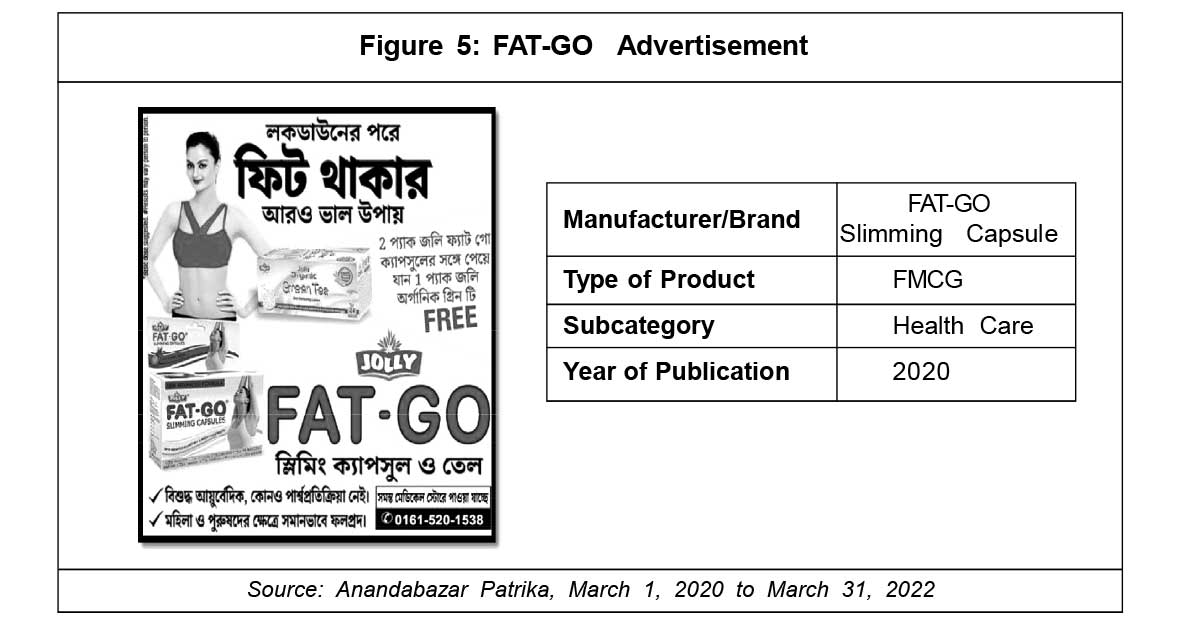
The advertisement for FAT-GO Slimming Capsule (Figure 5) was published in Anandabazar Patrika on May 29, 2020. Physical wellbeing and immunity-boosting seemed to be major concerns during the pandemic situation. It is not just men but also women who can acquire the fitness mantra to stay healthy, where she can assert a sense of perfection with particular reference to her 'body shape'. However, we must remember that the advertisement uses the term 'fitness' as a metaphor for 'slim/alluring body' and therefore centering the lives of women around their physical looks only. A healthy, flabby woman can also be fit, although she is never portrayed in these advertisements. Here lies the patriarchal prejudice. The woman in the FAT-GO Slimming Capsule advertisement seems to endorse some kind of style statement through the product. She typically plays a decorative role here. Her stereotypical role is further intensified through her expressions and posture. The advertisement for FAT-GO Slimming Capsule validates the strong influence of the 'male gaze', a concept developed by Mulvey (1999), from the perspective of a woman being presented and objectified for male fantasy:
In a world ordered by sexual imbalance, pleasure in looking has been split between active/male and passive/female. The determining male gaze projects its phantasy on to the female form which is styled accordingly. In their traditional exhibitionist role, women are simultaneously looked at and displayed, with their appearance coded for strong visual and erotic impact so that they can be said to connote to-be-looked-at-ness (Mulvey, 1999, p. 62).
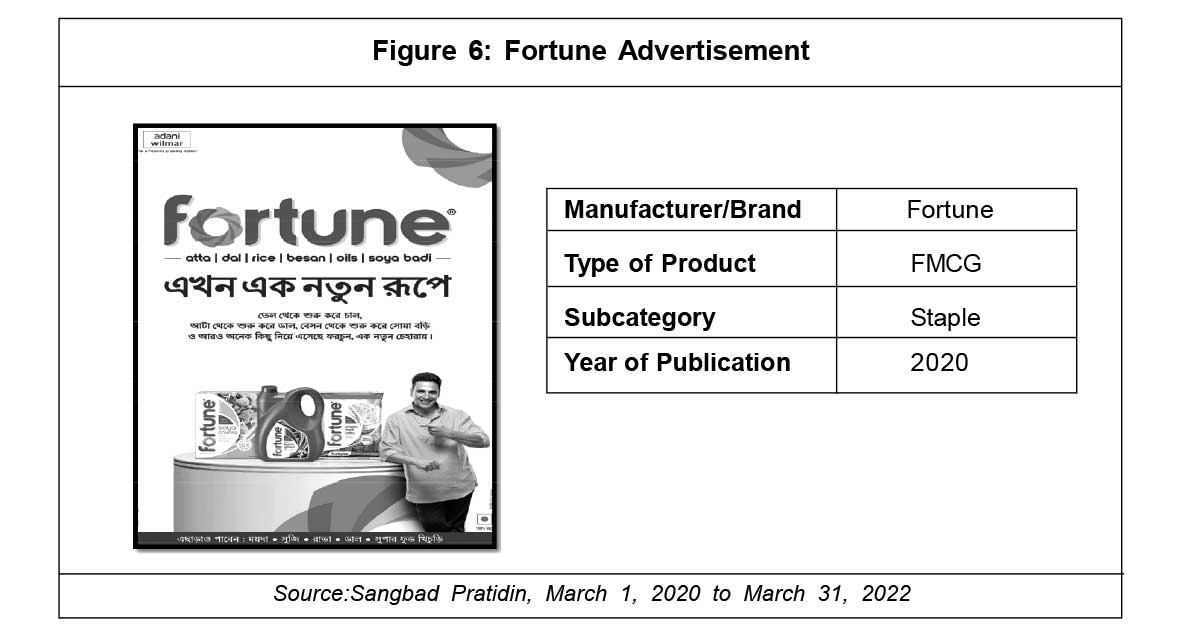
The increased presence of male celebrities in a recommendatory role in the advertisements on food products and disinfecting substances raises the question whether there is an indication that during the pandemic men were also becoming concerned about food habit and hygiene of the family. Although Bollywood actor Akshay Kumar, in the advertisement for staples manufactured by Fortune (Figuire 6) published in Sangbad Pratidin on March 6, 2020, suggests the consumers to use these particular products, he also plays a decorative role in the advertisement. The tagline "Fortune is now in a new form" corresponds to the new role of man in choosing the correct brand of staples for the family, although the question remains whether this man pitches in with culinary support. Here we also see Akshay Kumar wearing a quarter sleeve green shirt, which connotes a sense of vitality, freshness, growth, health and youthfulness. Perhaps, these newly and differently manufactured Fortune products will create a healthy family to combat the pandemic.
The advertisement for LIC (Figure 7) was published in Ei Samay on January 28, 2021. The catch phrase, as written on the top of the advertisement in white, conveys: "It is worth doing some work together and henceforth let us prepare for our future together." The couple in the LIC advertisement appears in a family role. The woman in the traditional Indian saree performs her traditional task, that is, cooking. Her partner stands beside her during cooking in the four-walled kitchen, although traditionally it is not the domain of a patriarchal man. The man does not participate in culinary activities directly, instead, he seems to supervise his partner, which can be seen from the movement of his fingers. The ranking of the man seems to be higher than that of the woman. The way the catchphrase is placed over his head in this advertisement emphasizes his decision-making role, the 'Head of the family'. Although he is portrayed as a family person, his primacy in financial decision making cannot be overlooked. Bhasin (1993) states that economic resources and property are controlled by men in a patriarchal society and very often women are even denied their financial rights. If one considers the relative size of the man in the advertisement, he seems almost equal to the woman and therefore there is no such ritualization of subordination evident in the LIC ad.

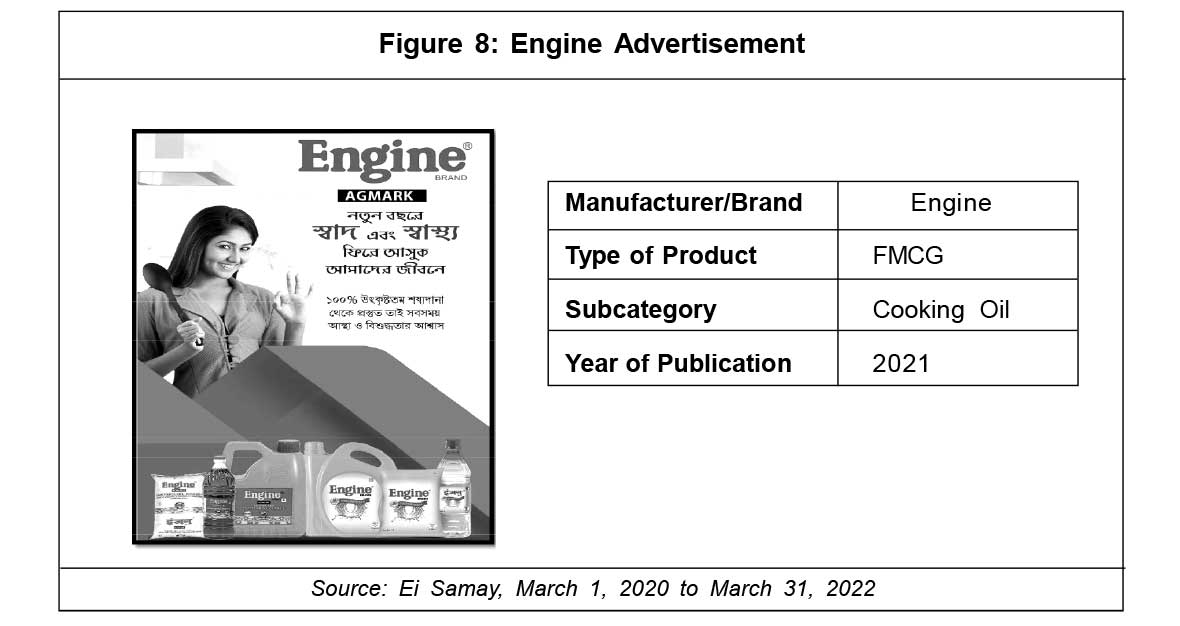
The catchphrase in the advertisement for Engine (Figure 8) published in Ei Samay on January 6, 2021 talks about "bringing taste and health in our life on the eve of New Year". Since it is being prepared from 100% finest grains, it is pure and reliable. This message gets intensified when the product itself is promoted by a woman who has been allocated the role of 'Home Manager' by the patriarchal system. The way the woman holds the cooking ladle establishes a sense of her authority/power in household matters. "In our patriarchal society, women have been the gatekeepers of health and nutrition, in good times and bad" (Bhowmik, 2020). During the pandemic, women's involvement in household chores and other domestic activities was increasing day by day. According to a UN Women report, "Whose Time to Care? Unpaid Care and Domestic Work During COVID-19", "Chores like cooking, shopping for groceries and cleaning, particularly to prevent infection, are all taking longer than ever. Although both women and men are bearing the increased burden, 60% of women and 54% of men reported that they have increased the amount of time they spend on unpaid domestic work since the pandemic began" (2020).
Although the woman in the Engine advertisement appears in a modern outfit with stylish hairstyle, she seems to play the role of a homemaker confined to the domestic space. She, moreover, performs a decorative role, adding glamor quotient to the product with the connotation of having glowing skin due to the regular consumption of healthy oil like Engine.
Das (2010) states that "the proportion of women appearing in ads for food, home, and beauty products was higher than that of men while the reverse was true in the case of ads for automobiles, financial services, and electronic items" (p. 218).
The catchphrase of Honda Amaze advertisement (Figure 9) can be translated as "This is not just smile but the assurance of Honda Amaze". We as the viewers can figuratively relate this catchphrase to the couple posing in the Honda Amaze advertisement: "This is not just smile, but the assurance of the husband." In this advertisement published on March 25, 2021 in Ei Samay, the wife appears in a typical traditional role who is apparently unaware of the financial matters of the family and is solely dependent on her husband. In this particular advertisement, she appears as a housewife who is supported by her husband which is understandable by the way he holds her and she clings to him. The husband appears in a traditional attire with an authoritative attitude in bestowing the family with a 'smile'. The color of the car in the advertisement is vibrant metallic red, which

gives an impression of vigor and activity, which is symbolic of the patriarchal man. The recipient role of the wife is magnified by her typical looks-'shankha', 'pola', 'sindur', 'bindi', 'saree in typical Bengali style'-fulfilling all the requirements of a 'good' traditional wife who is willing to abide by the patriarchal notions of the society with a smiling face. She may derive happiness in life when her husband certainly purchases Honda Amaze. She does not have the economic capacity to amaze herself on her own.
It is again noteworthy that the ranking of the husband is higher than that of the wife, and the size of the wife is typically smaller, connoting a sense of subordinate status of the woman within the family space. The catchphrase mentioned below the left-hand side of the husband, "Exciting benefits up to 47 000", seems to serve as the marker of his purchasing capability.
Metro Toned Milk or Metro Rich ensures uniform product consistency and uniform quality, making Keventer a trusted name in the dairy industry. The woman here becomes a metaphor for trust, purity and confidence. The way metro awakens the soul of Bengal and boosts the immunity of the entire population seems to parallel a wife's dedication and devotion towards her husband and family members for making their future a better one both mentally and physically. The advertisement published (Figure 10) in Ei Samay on September 24, 2020 portrays a relaxed couple enjoying morning tea in a much-nuanced manner, where we find the woman at the service of her husband. As noted by Goffman (1979, p. 43), "in advertisements, men tend to be located higher than women". Drawing on Goffman's notion of ritualization of subordination, it can be said that the relatively smaller size of the woman reveals her inferior position. She is not just the service provider but also the decision maker in household matters. Most importantly, she serves as the caregiver for the family ensuring the members a better
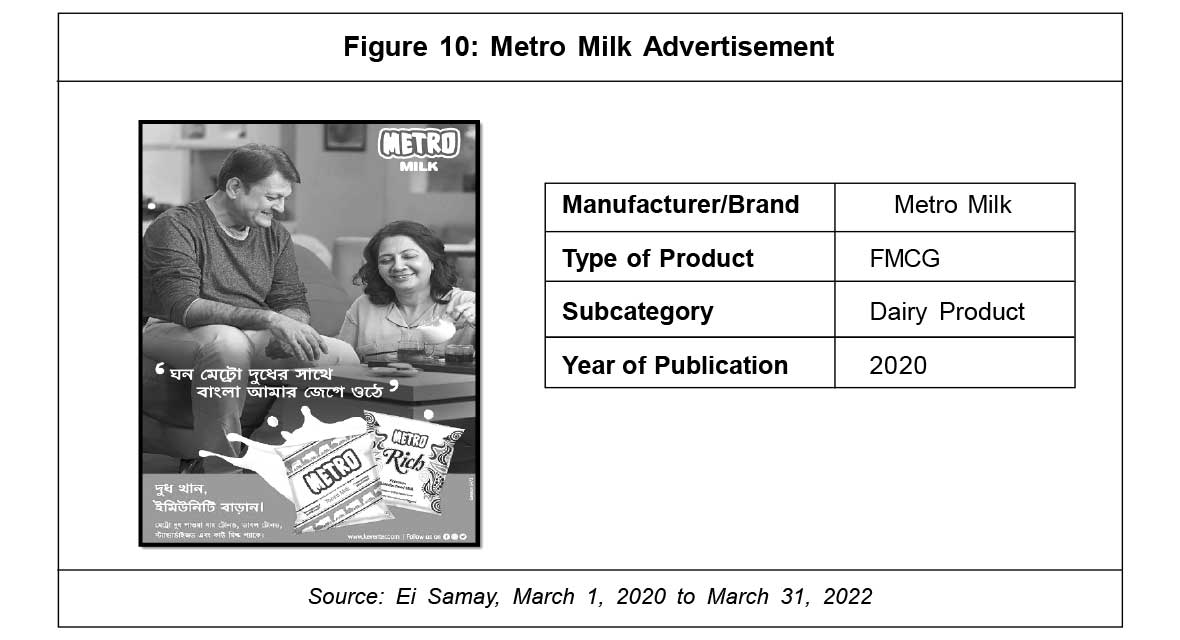
life and also providing an attentive ear to the loved ones, and demonstrating upkeep and support. The man here is playing an executive role, whereas the woman seems to have a lower functional ranking.
The advertisement for Asian Paints Smart Care (Figure 11) was published in Ei Samay on June 10, 2020, when the first wave of Covid-19 reached its peak in India. Usually, the monsoon arrives in India by early June, and therefore, this was the perfect time to advertise the above-mentioned product, although getting drenched in rain was literally unlikely during the season when the advertisement was published. Asian Paints Smart Care helps to protect against the leakage of the house for quite a prolonged period and is also formulated to protect against the damping of the interior walls. In this specific advertisement, we find two men playing the role of 'freewheelers' by enjoying the monsoon rain thoroughly. It is pointed out by researcher Dwivedy that freewheeler or fungoer role in a majority of instances is more acceptable for a man than a woman in the Indian context. Both the men in this advertisement are dancing on the roof top, connoting a sense of delight which is beyond the reach of women. The comparatively healthy man in a T-shirt creates the shape of snake hood, namely cobra, using his palm and fingers, which symbolizes power, respect and fear according to the Hindu mythology. Both the men have the patriarchal power to choose the lives they want, whereas women have to abide by the patriarchal norms imposed on them.
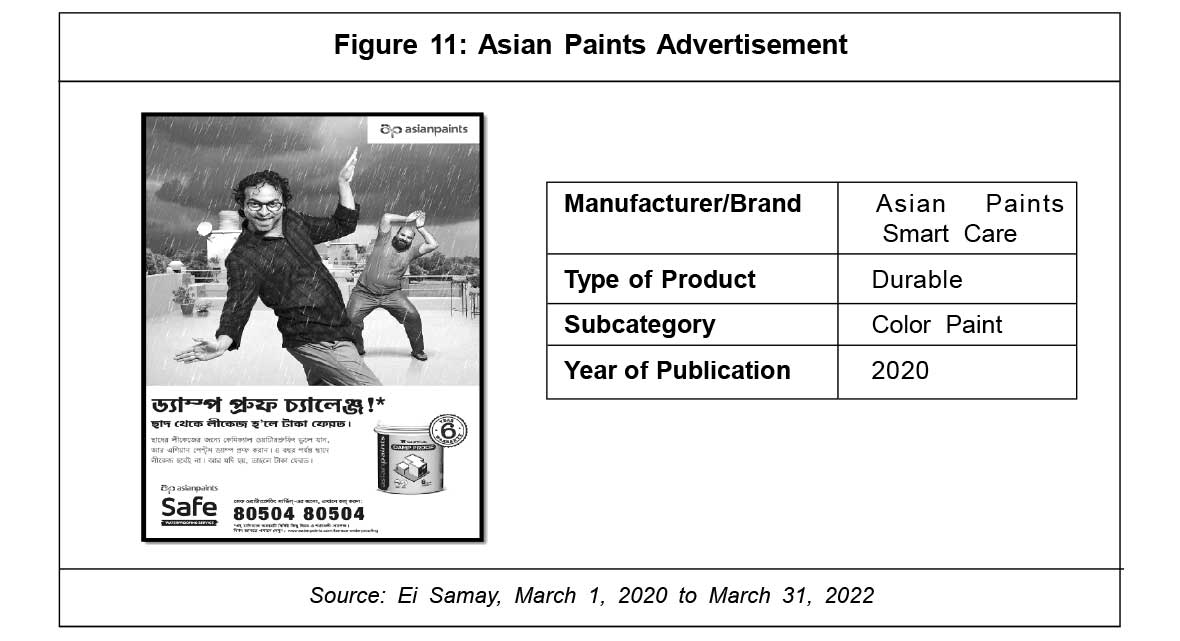
Most of the times, construction products seem to be associated with a man or a group of men, since the strength of the products can only be represented through the strength of well-built man/men. Sometimes, such advertisements do not even contain any women characters. The Asian Paints Smart Care ad is no exception here.
Gendering 'Work from Home'
The Keo Karpin body oil advertisement (Figure 12) was published in
Ei Samay on December 18, 2020, Keo Karpin Body Oil is an FMCG product meant for women consumers. The advertisement features Bengalee actress Arpita Chatterjee for the promotion of the product. She appears as an object of desire in this particular advertisement. While a celebrity endorsing a product is very common, some of the collective character roles played by women celebrities include either getting benefits out of the product, or playing an advisory/recommendatory role, or both. The presence of the celebrity in a domestic/private space also lends support to the fact that the advertisers are informing the women fraternity to use their product, so that they too can become such 'objects of desire' or 'beauty stereotype'. The illustration given in black ink at the bottom of the advertisement further reinforces the overall message intended-a user will have her beauty glow by using the product and thereby catering to the patriarchal expectations. Berger (1972) reveals that post-Renaissance European painting to modern day posters/advertisements have similarly rendered women as objects to satisfy the demands of hetero-normative society. Berger (1972) further argued that ultimately how women appear to men indicates the success of their life.
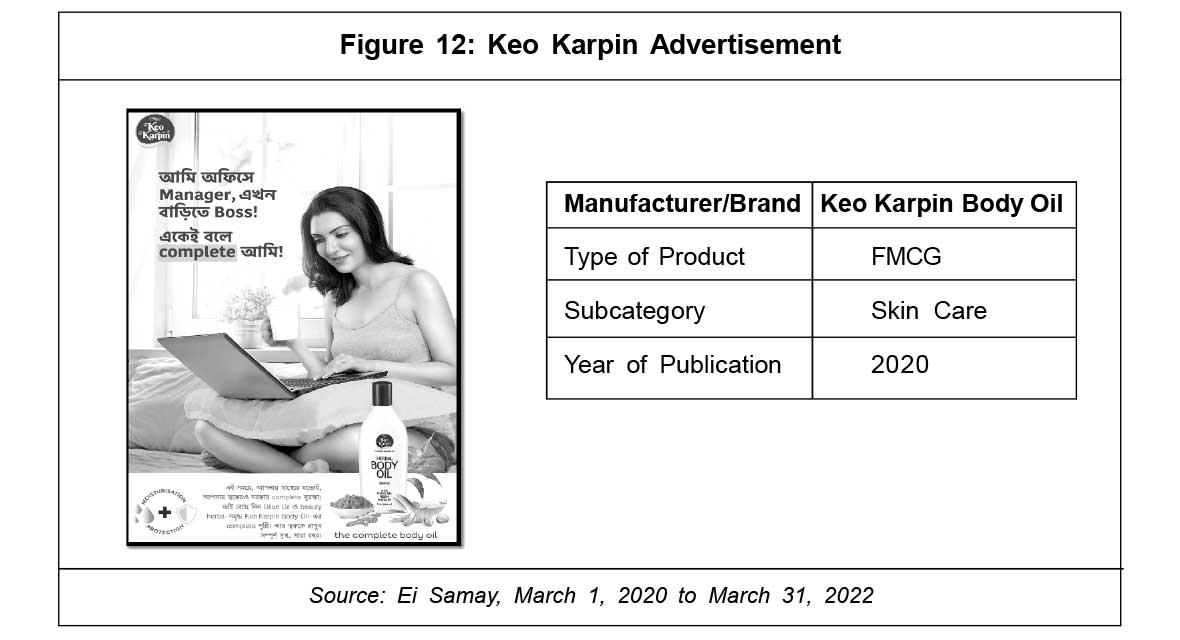
On the top left side, the catchphrase written in green can be translated as "I am the Manager at office and also the Boss at home! This is called the complete 'I'!" The word 'complete' is highlighted here. This advertisement suppresses the working role of a woman during WFH situation in pandemic and the woman lacks professionalism considering her attire, although she is carrying out her office work from home. The advertisement encourages the viewers (woman) to act like a superwoman who can take care of her looks as well as her household and office responsibilities. This kind of pressure, according to the contemporary feminists, is harmful for both the physical and mental health of a woman. This is rather a trap of the patriarchy, which demands women to be superwomen.
The Reserve Bank of India (RBI), which is responsible for the regulation of the Indian banking system in its advertisement (Figure 13), encourages women customers to draw loans from their own savings. Usually, in advertisements relating to financial matter, we see the man taking the prime decision and the woman appears in a dependent role. This advertisement presents us with a different narrative where a woman herself is performing financial task from home. Whether the woman herself is a professional or not is not obvious from the way she is represented in the advertisement. Here we can apply the 'work on yourself' concept where a person spends an adequate amount of time on improving his/her own condition.
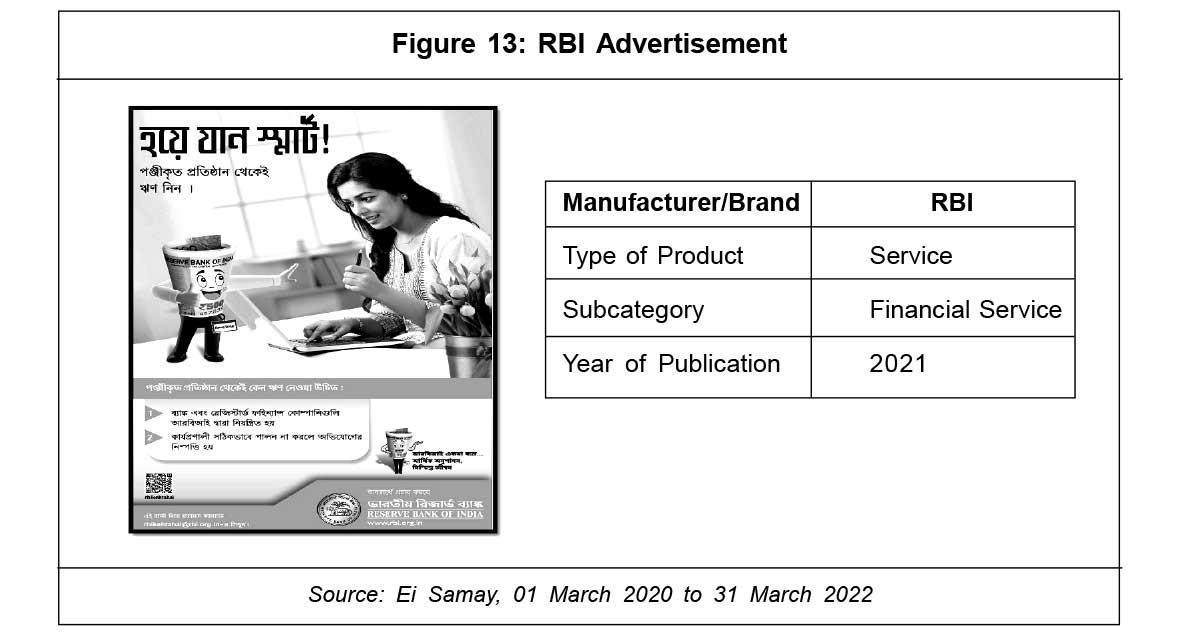
The RBI advertisement was published on March 15, 2021 in Ei Samay. It is obvious that an invisible man covered by Indian currency directs the woman's action and above the man we can see the catchphrase: "Act like a smart person." Here the man's role as a guide in financial matters has been valorized. In this advertisement, we see the woman looking at the man-a metaphor for financial matters-with a smiling face, which indicates her happiness and aspiring nature. As Bhasin (2000) puts it:
Women are the providers of services [of doing household activities and caring for the children and the elders], even in bourgeois or upper caste households. ...Jobs which entail authority, power and control are considered men's jobs and jobs involving caring, nurturing, servicing are seen as women's jobs. Women are subservient at home; they continue to be subservient outside. Men are in a position of power and [financial] control at home, they continue to be in similar positions in the outside world (2000, p. 36).
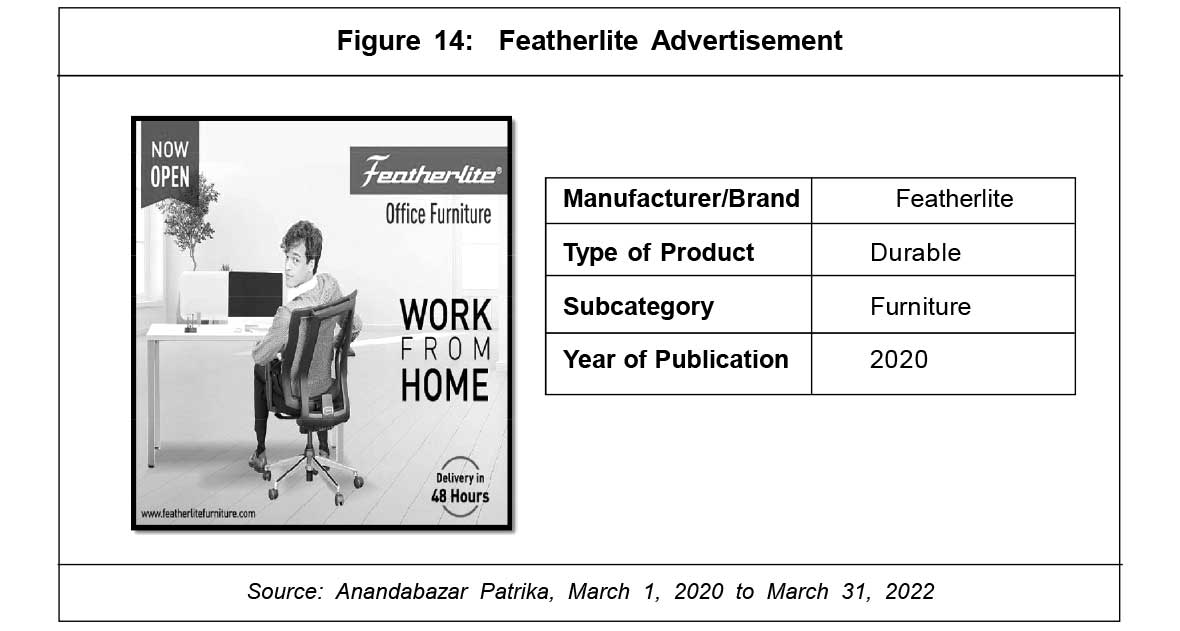
The advertisement for Featherlite office furniture (Figure 14) was published on May 28, 2020 in Anandabazar Patrika. The man here appears in a working role in a WFH situation during the pandemic. Although he is working from home, he is presented in a professional attire in a professional setup. It is evident from his body (reclining) posture that he is preoccupied with his work. The structure of the chair and desk conveys a sense of weightlessness, thus, justifying the brand name 'Featherlite'. In spite of all the adversities during the critical pandemic situation, the manufacturer gives an assurance to deliver the furniture required for working from home within 48 hours. It is surprising that in the advertisements of post-pandemic period, women are completely missing from this type of professional setup, though they too were working from home. Although the advertisement was published in a Bengali daily, the language of the advertisement is English, presenting the working man as a global standard.
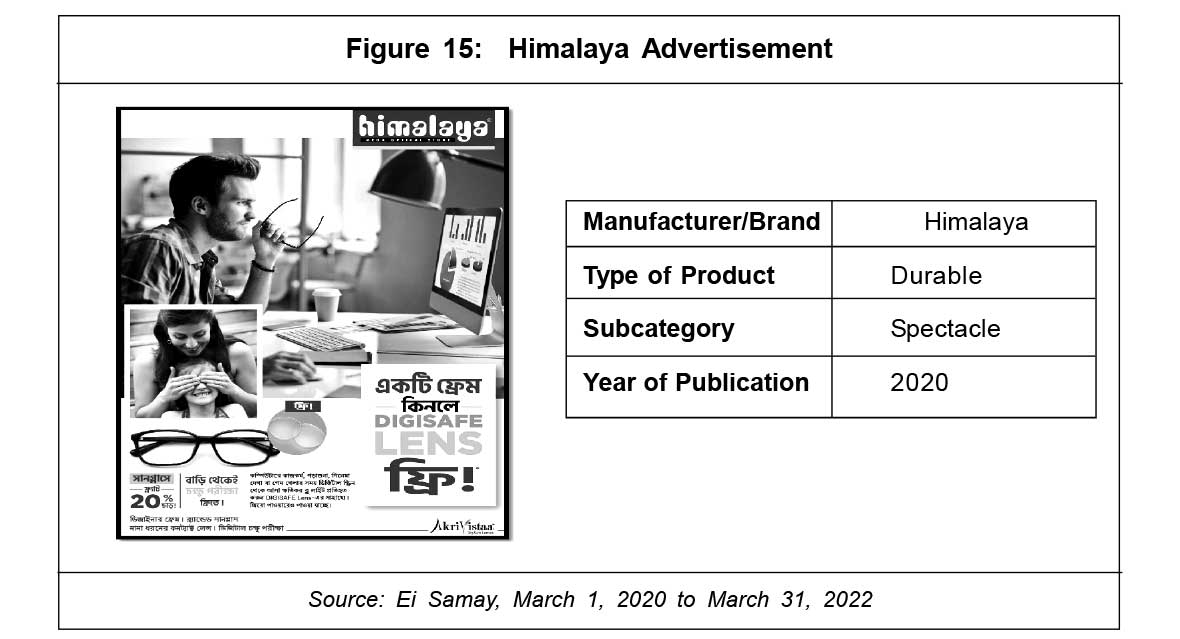
The Himalaya advertisement for spectacle frames (Figure 15) was published on October 17, 2020 in Ei Samay. Here we see a Caucasian man working from home and simultaneously we find the mother-daughter duo in a very jovial mood, although in a different frame. It is apparently difficult to establish a relationship between the Caucasian man and the mother-daughter duo. The catchphrase written at the bottom left mentions that the eye check-up can be done at home itself. It is also mentioned at the bottom right that a single frame comes with free DIGISAFE lens. As mentioned in the advertisement, this lens is meant for protecting eyes from the blue light emitted by digital screen during working, studying or watching movies on computer. In this advertisement, the man only seems to be working using his PC, whereas the mother is portrayed covering her daughter's eyes which connotes a sense of protecting her daughter's eyes from the harmful light. Basically, the advertisement portrays the man and woman in two different roles-working role and family role.
Conclusion
The study found that in 2020, during the first wave of Covid-19, the Bengali print advertisements mostly focused on healthcare protocols, social distancing and WFH situation, though there were not many advertisements showing women working from home. The study also found that when the second wave of Covid-19 hit the country, the number of Bengali print advertisements with WFH background drastically declined, except for a few primarily portraying men. Later in India, when the WFH strategy was gradually implemented by different organizations on a larger scale, the Bengali print advertisements focused more on the other aspects of life; therefore, it can be said that there has been a huge gap between what was happening on the Indian work front and what was being presented by the Bengali print advertisements during the later phase of Covid-19. The current study which is solely based on Bengali print advertisement may initiate discussions on advertisements relating to WFH situation published in different languages in other parts of the country during the pandemic. In future, there is a larger scope for doing a comparative study of the advertisements covering WFH situation across India during the pandemic which may usher in a different findings.
The study provided insights on the social construct of gender roles in Bengali print advertisements published during the pandemic period. The primary roles played by women in advertisements during the pandemic are more skewed towards two particular roles-family role and decorative role. Depiction of woman as a central character in a freewheeler role is absent in the post-pandemic Bengali print advertisements. In some, there is a tendency to depict woman as a 'superwoman'. Some of the advertisements project man in advisory role for promoting household products, although his participation in housework during the pandemic situation was hardly mentioned. Unfortunately, the number of ads representing both women and men working from home was quantitatively poor.
The increased presence of male celebrities in a recommendatory role in the post- pandemic Bengali print advertisements on food products and disinfecting substances raises the question whether there is an indication that during the pandemic men were also increasingly concerned about the food habits and hygiene of the family. Again, it must be mentioned that in many advertisements, women have been literally shown preparing food, disinfecting floors and sanitizing the hands of the children. Ironically, while male celebrities are shown recommending the use of the products, middle-class Indian women are shown using the product for the family.
The social, economic, and psychological consequences of WFH along with the issues and challenges faced by the employees across gender, particularly women, have not been adequately explored or addressed in the advertisements published in Bengali dailies during the pandemic. The advertisements have failed to trace or portray the ambiguities women confronted both in 'work for home' and 'work from home' circumstances. Although an effort to avoid stereotyping of gender roles in these advertisements is visible, it is not adequate to usher in transformation of gender roles or eradicate the gender divide. Since human mind is very susceptible, the advertisers must be careful before projecting any specific gender ideal.
References
- Anandabazaar Patrika, March 01, 2020 to March 31, 2022.
- Beauvoir Simone de (1949), The Second Sex, Vintage Publishing, UK.
- Berger John (1972), Ways of Seeing, Penguin, UK.
- Bhasin Kamla (1993), What is Patriarchy?, Kali for Women, New Delhi.
- Bhasin Kamla (2000), Understanding Gender, Kali for Women, New Delhi.
- Bhowmik Tanushree (2020), "Even Before Coronavirus, Indian Women were Passing Down Secrets of Quarantine Cooking", https://scroll.in/magazine/958792/even-before-coronavirus-indian-women-were-passing-down-secrets-of-lockdown-cooking-for-generations accessed on November 03 , 2022.
- Blackstone Amy (2003), "Gender Roles and Society", in Julia R Miller, Richard M Lerner, Lawrence B Schiamberg and Santa Barbar (Ed.), Human Ecology: An Encyclopedia of Children, Families, Communities, and Environments, pp. 335-338, ABC-CLIO, CA.
- Boghossian Paul A (2001), "What Is Social Construction?", Times Literary Supplement, February 23, pp. 6-18.
- Chaudhuri Maitrayee (2001), "Gender and Advertisement: The Rhetoric of Globalization", Women's Studies International Forum, Vol. 24, Nos. 3&4, pp. 373-385.
- Courtney A and Lockeretz S (1971), "A Woman's Place: An Analysis of the Roles Portrayed by Women in Magazine Advertisements", Journal of Marketing Research, Vol. 8, No. 1, pp. 92-95.
- Das Mallika (2010), "Gender Role Portrayals in Indian Television Ads", Sex Roles, Vol. 64, pp. 208-222.
- Dwivedy A K, Patnaik P and Suar D (2009), "Audience Response to Gender Role Portrayals in Indian Advertisements", Journal of Creative Communications, Vol. 4, No. 2, pp. 65-85.
- Ei Samay, March 01, 2020 to March 31, 2022.
- Goffman Erving (1979), Gender Advertisements, Harper and Row Publishers Inc., New York.
- Krippendorff K (2004), Content Analysis: An Introduction to Its Methodology, Sage Publications, London, UK.
- Lindner Katharina (2004), "Images of Women in General Interest and Fashion Magazine Advertisements from 1955 to 2002", Sex Roles, Vol. 51, Nos. 7&8, pp. 409-420.
- McKinsey (2021), COVID-19: Implications for Business in 2021, https://www.mckinsey.com/capabilities/risk-and-resilience/our-insights/covid-19-implications-for-business-2021. Accessed on December 16, 2022
- Mulvey, Laura (1999), "Visual Pleasure and Narrative Cinema", in Leo Braudy and Marshall Cohen (Eds.), Film Theory and Criticism: Introductory Readings, pp. 833-44. Oxford UP, New York.
- Ogilvy David (1985), Ogilvy on Advertising, Vintage Books, USA.
- Pollay R (1986), "The Distorted Mirror: Reflections on the Unintended Consequences of Advertising", Journal of Marketing, Vol. 50, pp. 18-36.
- Sangbad Pratidin, March 01, 2020 to March 31, 2022.
- Sharda A L (2021), "The Advertising World Needs to Focus on "Women in Leadership", https://www.campaignindia.in/article/opinion-the-advertising-world-needs-to-focus-on-women-in-leadership/468178. Accessed on December 10, 2022.
- Simon R (1980), "Advertising as Literature: The Utopian Fiction of the American Marketplace", Texas Studies in Literature and Language, Vol. 22, No. 2, pp. 154-174.
- Stokes David and Wendy Lomax (2008), Marketing: A Brief Introduction, Jennifer Pegg, United Kingdom.
- Williams R (1980), Advertising: The Magic System, In Problems in Materialism and Culture, Verso, London.
-
Websites
- Are brands keeping up with pandemic-driven shifts in gender roles? https://investinginwomen.asia/posts/brands-keeping-up-pandemic-driven-shifts-gender-roles/ accessed on December 21, 2022.
- Expert Speak: Representation of women in ads - how close are we to reality? https://www.socialsamosa.com/2022/03/expert-speak-representation-of-women-in-ads-reality-check/ accessed on December 15, 2022.
- Whose Time To Care? Unpaid Care and Domestic Work during Covid-19. https://data.unwomen.org/sites/default/files/inline-files/Whose-time-to-care-brief_0.pdf accessed on December 16, 2022.