April'23
The IUP Journal of Organizational Behavior
Archives
Theoretical, Practical and Managerial Implications of Work from Home: A Systematic Literature Review
U Naganjani
Research Scholar, School of Management Studies, University of Hyderabad, Hyderabad, Telangana, India; and is the corresponding author. E-mail: unaganjani@gmail.com
Sita Vanka
Senior Professor, School of Management Studies, University of Hyderabad, Hyderabad, Telangana, India. E-mail: vankasita@gmail.com
The Covid-19 pandemic has shattered the traditional assumptions about work, work design and workforce management, resulting in a radical shift in the work environment: the concept of Work From Home (WFH). Leaders and managers found a unique opportunity to break from a location-centric model of work to redesign it around a human-centric model to deliver both business outcomes and secure employee output. Organizational experience proves that the current work design is characterized by flexibility and empathy where the employees feel more empowered, thus increasing their productivity and performance. Surveys have predicted the hybrid model of working as the 'new normal' for employees. There is abundant research on the impact of remote work/flexible work on employees and organizations, forming a rich body of literature. This study seeks to analyze the impact through a systematic literature review for theoretical, practical and managerial implications in a mandated WFH context.
Introduction
Work From Home (WFH), although a universal topic in the current scenario, is not a novel or path-breaking concept. Prior literature evidenced WFH as a 'perk', 'benefit' or part of organizational policy to enhance employees' work-life balance and provide flexible work arrangement as an additional incentive (Timsal and Awais, 2016). WFH also gained momentum with the advent of IS and ICT in the work fields. IT sector and multinational companies where virtual teams and remote locations are a commonplace, had policies and provisions for 'remote work' and WFH options (Popovici and Popovici, 2020). Eventually, WFH has been adopted as a company policy in several corporates owing to its benefits like improved work-life balance (Shagvaliyeva and Yazdanifard, 2014), better performance of employees and profitability of companies (Bloom et al., 2015), and advantages of WFH (Ipsen et al., 2020) for the employees like work flexibility and increased employee autonomy.
A positive response from value-driven and people-centric organizations (Berman and Thurkow, 2020) with sector-specific policy (IT and ITES) (Singh et al., 2020), flexibility at work for women (Submitter et al., 2021) as an alternative work schedule for their convenience (Smite et al., 2021) is being practiced in the current context.
It was rightly said long ago that from time to time, "organizational environments undergo cataclysmic upheavals-changes so sudden and extensive that they alter the trajectories of entire industries, overwhelm the adaptive capacities of resilient organizations, and surpass the comprehension of seasoned managers" (Meyer et al., 1990). The effect of Covid-19 pandemic on the industry and individuals alike perfectly sums up this quote by Meyer et al. (1990). It has pushed organizations across the globe to undertake unprecedented and unforeseen risks to continue their operations and stay in business (Yue et al., 2020). Business leaders and HR managers scrambled to keep the businesses afloat while taking care of employees and following the Covid-19 protocols. WFH, although a known occurrence in the corporate environment, became a standard practice and the only available option during the pandemic, giving rise to a multitude of hitherto unseen implications and challenges to not only the management but also employees and their families. The ripple effect of this impromptu shift in work design has immediate as well as long-term consequences. The issues emerging from the pandemic induced mandatory WFH appear to be substantially diverse and are yet to be uncovered. The research shows the emerging issues in diverse perspectives and contexts to understand and strategize for future. The results are not only diverse but also directionless. This is reiterated by the surveys (Ipsen et al., 2020) which highlighted conflicting views of employees, managers and organizations, thus necessitating further investigation. This study attempts to examine and analyze the literature, using the systematic literature review tool, to answer specific research questions using a systematic and explicit methodology to identify, select, and critically evaluate results of the studies included in the literature review (Rother, 2007). It also endeavors to define the direction of literature for theoretical, practical and managerial implications of mandated WFH and proposes research direction based on the results of the literature review.
Methodology
The systematic literature review is a tool to manage the diversity of knowledge for a specific academic enquiry (Tranfield et al., 2003). It is a tool to analyze and describe the state of the topic or a theme in a theoretical and contextual point. It is a well-planned review to answer specific research questions (Rother, 2007) and an essential tool to explore the length and breadth of a topic to highlight the gaps in the existing body of knowledge through aggregation, interpretation, explanation and integration (Xiao and Watson, 2019). A literature review is also critical in explaining the uncertainty in the results of prior research owing to the limitations in research methods, objectives, context and sample selection (Adams et al., 2017). Covid-19 and post-pandemic period witnessed a surge in research activity related to WFH in different contexts and perspectives, leading to a vast body of knowledge with mixed results and multilateral outcomes. Against this background, the paper aims to explore the existing body of knowledge related to WFH in different contexts to provide a comprehensive understanding of the topic and future directions of further research, along with the managerial and organizational implications. The protocol proposed by Van Dinter et al. (2021) was used with necessary modifications to suit the requirements. The following steps of identifying the research target, defining the search strategy, establishing search boundaries, defining the inclusion and exclusion criteria, constructing the search string, literature search, data extraction, data synthesis and review writing were followed. Establishing a research target or research question as a first step plays a pivotal role in SLR, as the research design and methods deployed are expected to answer these questions adequately in the later stages (Bryman, 2007). The following research questions guide the investigation:
RQ1. What are the employee experiences during mandated WFH during Covid-19?
RQ2. What was the organizational response during mandated WFH during Covid-19?
RQ3. What are the social, psychological and economic implications for employees in education and IT sector?
RQ4. Do women face different challenges due to the mandated WFH?
The search strategy was to collect as many primary studies as possible within the search criteria to establish a concrete base/body of knowledge for analysis. A precise strategy, with well-defined scope of search, including the search boundaries, exclusion and inclusion criteria and a search string, maintains the precision of the research (Van Dinter et al., 2021). A clearly defined scope will ease and expedite the search and analysis. The study includes papers published during the pandemic and the post- pandemic period. The boundary dates of 01.01.2020 to 01.05.2022 were used for search criteria. The search criteria included papers from Mendeley and Scopus which are the highly searched and acclaimed database of good quality peer-reviewed journals in the field of management. The exclusion criteria were non-English and duplicate papers to increase the precision of search.The research path based on the criteria is given in Figure 1.
Based on the scope and research questions, a set of keywords were used to find the relevant papers in the predefined databases. The keywords-work from home, pandemic, employees, Covid-19, employee wellbeing, employee productivity and employee performance-were used to retrieve the papers. The keywords were set to include titles, keywords and abstracts in the database. The papers reviewed included English language scholarly journals in the field of business management, and related fields.
The papers thus extracted based on the predetermined criteria were entered into an Excel sheet along with the relevant details of authors, journal, year of publication, title, field of research, keywords and objectives. The duplicate and non-English papers were
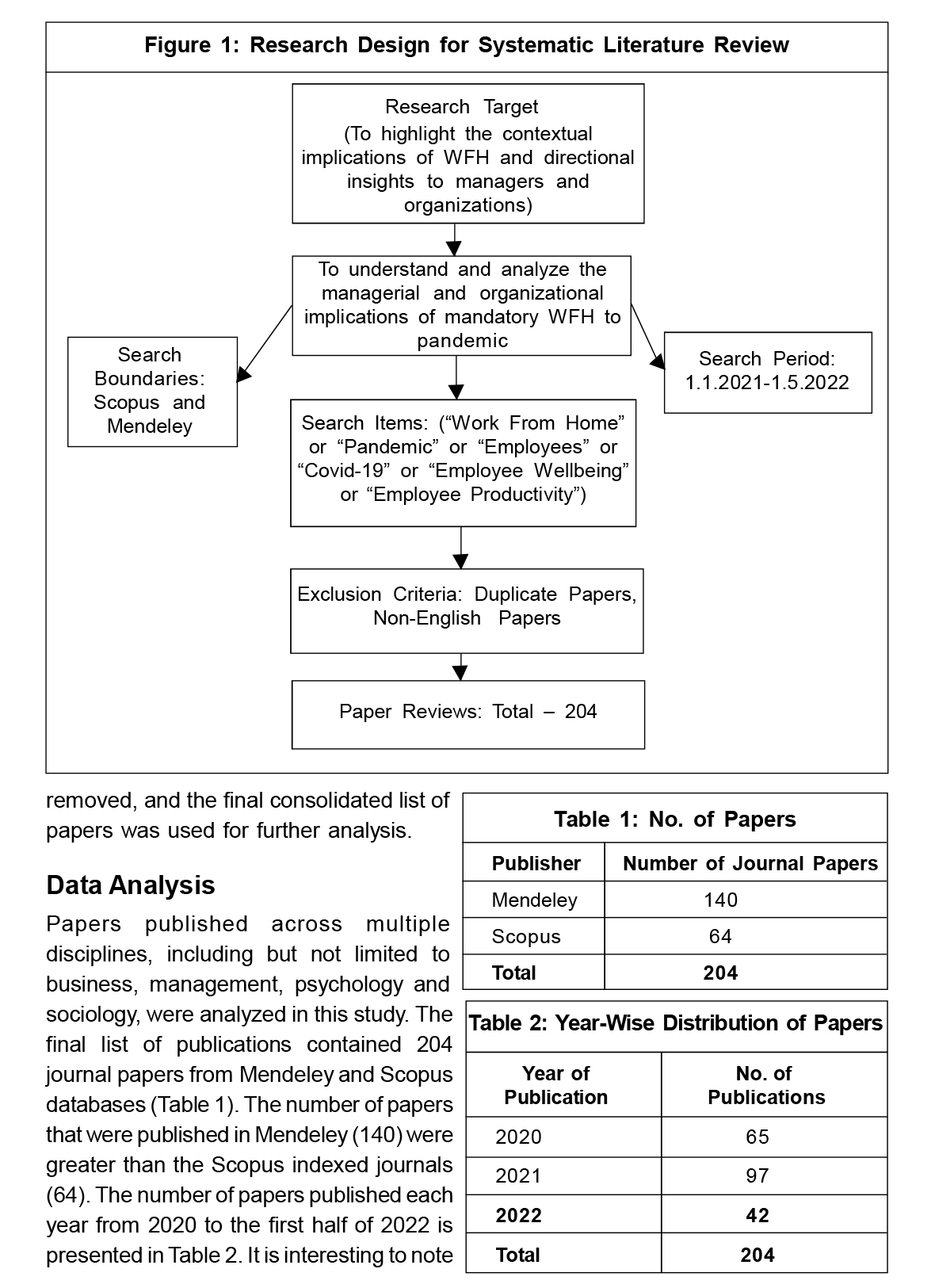
that the number of publications during the pandemic period is more compared to the pre-pandemic period due to the extensive research carried out on implications of WFH from different perspectives. Prima facie, a deep dive into the journals that the papers are published in shows that the research activity is dispersed among a broad range of contexts and across the spectrum. This highlights the multidisciplinary research/impact of mandatory WFH. Both qualitative and empirical papers appearing across the database that addressed the implications of WFH were considered, with a highest number of papers published in International Journal of Environmental Research and Public Health and SSRN journal (n = 8).
Results
WFH is a multidimensional concept drawing from different disciplines-business, management, psychology, sociology, medicine and IT, to name a few. A majority of the papers were published during the pandemic period analyzing the implications from different perspectives in different contexts across a broad spectrum. The results highlight a limited number of Scopus-indexed journals, which indicate the effect of lockdown and pandemic on the world of publishing. WFH has ignited the motivation and interest of researchers to examine the emerging issues and challenges faced by the employees and organizations as it has a great potential to influence the world of work in the foreseeable future. The most significant changes in the organizations like workforce redesign and digitalization to adapt to the Covid-19 protocols are game changers in the world of work. The employee experience, organizational response, issues, implications and challenges are presented.
Employee Experience During Mandated WFH
Mandatory WFH situation has challenged the conventional distinction between 'office/work time' and 'family/me time', leading to the emergence of 'work-life balance' issues among the employees (Gorjifard and Crawford, 2021). Work-life balance denotes being able to maintain a balance between work (career and ambition) and life (family, happiness and leisure) to achieve and savor success (Putri and Amran, 2021). Evidence shows work-life balance in positive and negative light. While some studies argued that WFH improved work-life balance of the employees (Ipsen et al., 2021), others argued otherwise (Irawanto et al., 2021). Blurred boundaries between working and non-working hours was a consequence of flexible work design during the pandemic, resulting in extended work hours and work stress among the employees. Research also shows contradictory findings related to work efficiency and work control (Pathak, 2021). Further, increased costs for setting up a suitable work station, maintaining daily routine and self-discipline (Russo et al., 2021) disrupted work-life balance leading to weakened employee wellbeing were also highlighted by researchers (Elnanto and Suharti, 2021).
Organizational Response During Mandated WFH
WFH, per se, in some sectors is a common practice, however a 'mandatory' overall workforce shift to WFH is an organizational crisis brought forth by the pandemic. Research shows that some organizations were working towards a rapid workforce realignment to follow the Covid-19 protocol (Chen, 2021) and industries like IT and allied businesses had a policy in place for WFH (Singh et al., 2020). Kniffin et al. (2021) found that virtual team work, virtual management and leadership played a vital role during the onset of the pandemic to provide additional support to the employees in the crucial period of change along with additional moral and professional support. A study by Singh et al. (2020) found that organizational culture and values had a critical role in organizational response towards mandated WFH during the pandemic. This view was supported by Berman and Thurkow (2020) when they observed that value-driven and people-centric organizations had a better response towards WFH without compromising on employee wellbeing and performance while maintaining their profitability.
Social, Psychological and Economic Implications for Employees
WFH in the backdrop of pandemic along with social distancing and global health crisis and work uncertainty impacted the mental health of employees (Phadnis et al., 2021). WFH during the pandemic initially demonstrated benefits to the employees and organizations. Xiao et al. (2021) observed that while there are considerable benefits of WFH during the pandemic like work flexibility, commute time savings, and controlled work environment, employees on extended WFH showed an impact on their mental health due to lack of social interaction, work isolation and disturbed routines and eating habits. The dark side of extended WFH highlighted the impact on the mental health of the employees, which directly affected their productivity and job satisfaction (Ardi et al., 2021). It is observed that extended work from home resulted in increased workload, job insecurity, poor work environment, personal problems and lack of structure leading to occupational stress (Thomas, 2021). In addition to mental health issues, studies also evidenced an increase in other health issues like insomnia and postural problems arising during the WFH period among the employees (Wutschert et al., 2021). Increased costs for setting up work stations and maintaining daily routines affected the employee and his wellbeing (Russo et al., 2021).
Issues and Challenges Faced by Women During the Pandemic
Prolonged period of pandemic and consequent WFH environment influenced individuals differently. Scholars highlighted that the effect of WFH on men and women was different owing to the traditionally gendered division of labor in the society (Yildrim et al., 2021). It was also found that physical distancing, dread, vulnerability, and prolonged remote working exposed an enormous number of women in the IT sector to challenges related to emotional, physical and mental wellbeing (Thomas, 2021). Studies also revealed that the need to balance between work, house work, and parental responsibilities due to closure of schools (Joiko, 2022) created increased stress levels and physical workload among women employees (Sharma and Vaish, 2020). Neo et al. (2022) studied the 'work-family conflict' among women due to the clash of work, family and parental commitments.
Discussion
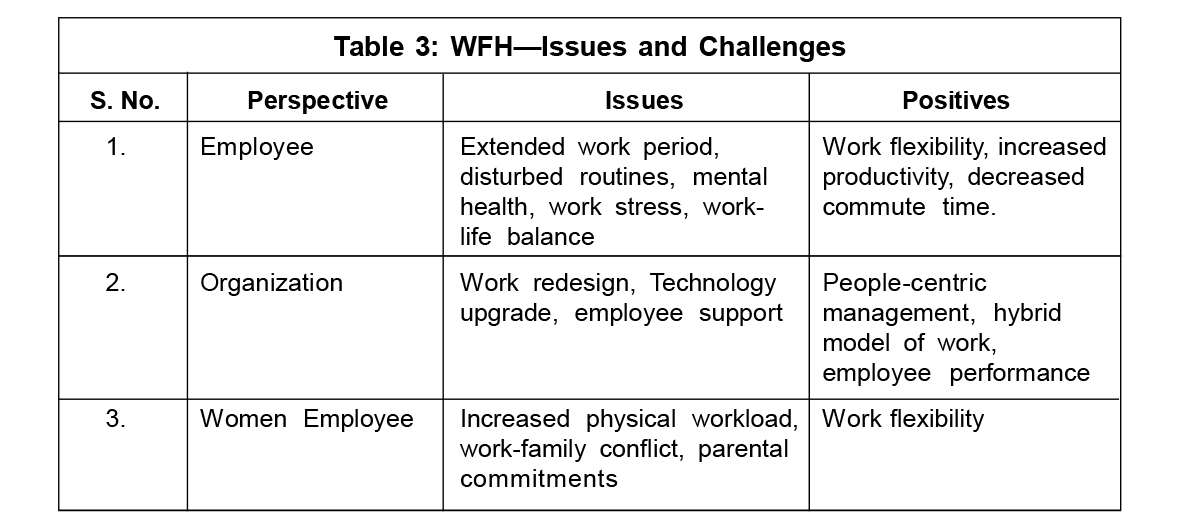
Covid-19 pandemic has created a plethora of situations in diverse contexts, resulting in issues and challenges faced by all the stakeholders of business. The systematic review of literature on WFH from employee and organizational perspective has brought forth multiple interrelated issues (Table 3).
Work Flexibility and Extended Work Period
Studies conducted on WFH frequently highlighted work flexibility as a positive effect while extended work period was categorized as a negative outcome of prolonged WFH arrangement during the pandemic (Submitter et al., 2021). On the one hand, work flexibility resulted in employees having an alternative work schedule of their convenience (Smite et al., 2021) and in procrastination and low efficiency , leading to disrupted work schedules and blurred distinction between 'work time' and 'family time'. Evidence suggests that prolonged WFH combined with the pandemic resulted in decreased motivation levels among the employees, leading to a slew of other issues-low motivation levels, low job commitment and lower job satisfaction (Sultana et al., 2021). Work flexibility decreased the commute time and was welcomed by the employees in the initial stages of the pandemic. However, the extended restrictions and the consequent uncertainty more in the nature of a reactionary response from the organizations, leaving no room for organizational planning, disturbed the employees' work routine.
Work-Life Balance
Work-life balance has been one of the factors extensively studied in various contexts, however, the pandemic-induced WFH added a new dimension to the ongoing discussion. A review of prior research indicates that it is a chain of interrelated events rather than any one single factor that resulted in disturbed work-life balance during the pandemic (Schade et al., 2021; and Mehta, 2022). Dealing with health crisis, career shock (Akkermans et al., 2020), and family distractions (Kumar et al., 2021) are but a few of the many antecedents that affected the work-life balance of the employees during the pandemic. Factors like job autonomy, supervisor support, social/peer interaction, work demands, overtime, and family support were found to be impacting the employees' work-life balance (Stankevieiute and Kunskaja, 2022). The direction of the impact of these factors varied due to contextual and individual factors. The positive and negative direction of the impact was dependent on the career and life stage of the individual (Zarbo et al., 2021).
Work Stress and Mental Health
Work stress resulting in mental health issues was a challenge to the organizations, employees and their families during the pandemic. Stress due to work uncertainty, worry about the future, career progression after pandemic decline, lack of social interaction at the workplace combined with non-work-related stressors specific to the pandemic impacted employee mental health (Jaiswal and Arun, 2020). Concerns about future job loss and displacement due to changed market conditions evidenced during the pandemic led to stress among the employees (Zarbo et al., 2021). Employees with minimal exposure to digital skills faced a different set of difficulties at workplace due to sudden shift to virtual work, leading to increased work burden.
Employee Productivity and Job Performance
The pandemic resulted in an unprepared shift of work from office to WFH, leading to work uncertainty and reduced organizational and peer interaction among the employees. As evidenced in the other factors, employee performance and productivity also showed considerable variation throughout the pandemic period (Patanjali and Bhatta, 2022). A fall in employee productivity immediately after lockdown was evidenced (Bernstein et al., 2020) due to the abrupt unprepared change in work conditions, leading to confusion and loss of task identity among the employees. However, productivity and performance were back to normal once the employees adapted to WFH and the organizations put across suitable processes in place (Angelici and Profeta, 2020). Increased productivity can also be attributed to the absence of work travel, flexibility of work, and decrease in non-work-related activities during office hours and increased work time (Sridhar and Bhattacharya, 2020). Further, experience revealed a decline in productivity as the pandemic progressed, which can be attributed to the decreased employee motivation, prolonged work hours, and disturbed work-life balance.
Organizational Support - Virtual Teams and Virtual Leadership
Literature emphasized the significance of organizational support to employee motivation, performance and productivity, and this became more apparent during the pandemic when organizations struggled to maintain a balance between employee welfare, business operations and pandemic restrictions (Kniffin et al., 2021). On the organizational front, digital transformation, workforce upskilling and work redesign are some of the key issues that the management and managers focused on during the WFH period (Savic, 2020). Organizations, in the initial stages of the pandemic, focused on the digital transformation of operations, creating virtual (remote) teams. However, as the pandemic progressed, the organizations focused on employee wellbeing, managerial support and virtual leadership to address employee mental health and work-life balance issues.
Women Employee: Work-Family Conflict and Parental Commitments
Research on the effect of the pandemic on women employees brought forward issues that are specific to women, owing to the responsibilities and roles that are conventionally performed by women in a family setting (DelBoca et al., 2020). Childcare, parental commitments and household chores like cooking added to the work load of women employees, especially when external support systems like school and childcare centers were closed during the pandemic. Research highlighted that women employees with toddlers at home were more prone to work overload, stress and physical exhaustion during the pandemic, as compared to those having teenagers at home. Research found that work and care roles are still highly gendered (Scheiman et al., 2021; and Bernhardt
et al., 2022).
Conclusion
The Covid-19 pandemic has highlighted a host of hitherto unknown issues, challenges and implications in terms of business, work and family. A literature scan reveals disproportionate impact of Covid-19 on businesses and employees due to demographic characteristics, individual capabilities, organizational response and policies. This study confirms the ambiguity found in research. This may be attributed to the interplay of individual characteristics and contextual diversity. Hence, future studies can explore individual characteristics like age, career stage (fresher, middle and senior level) and situational factors and their impact of WFH. Further, work flexibility embedded in WFH aroused mixed reactions from the employees in general, more so from women. Alternative work schedules and work redesign based on the convenience of employees and gender roles could be experimented by managers and conceptualized by scholars. This could be investigated in a cultural setting like India, which demonstrates unique gender roles and family setting to highlight the contextual variation. Similarly, work and non-work related stressors induced by the pandemic impacted employee health. Employee engagement and support measures to suit the emerging model of work leading to people-centric management could be attempted by the managers to ensure employee wellbeing, pioneering new model/frameworks in the process. Moreover, the mandated WFH due to Covid-19 has impacted organizations and people in all walks of life. Future studies can understand its impact on organizational policies/governance, including the organizations' need to have a process in place to address such adverse situations. This assumes significance as surveys (Mckinsey, 2020) project either WFH or a hybrid mode of work in the times to come.
References
- Adams R J, Smart P and Huff A S (2017), "Shades of Grey: Guidelines for Working with the Grey Literature in Systematic Reviews for Management and Organizational Studies", International Journal of Management Reviews, Vol. 19, No. 4, pp. 432-454.
- Akkermans J, Richardson J and Kraimer M L (2020), "The Covid-19 Crisis as a Career Shock: Implications for Careers and Vocational Behavior", Journal of Vocational Behavior, Vol. 119, June, p. 103434.
- Angelici M and Profeta P (2020), "Smart-Working: Work Flexibility without Constraints", CESifo Working Paper No. 8165.
- Ardi Z, Mharchelya M and Ifdil I (2021), "The Employee's Job Satisfaction During Pandemic Covid-19 and the Counselor's Role", Journal of Counseling and Educational Technology, Vol. 4, No. 1, pp. 5-10.
- Berman Marc, and Thurkow Tracy (2020), "Covid-19 Creates a Moment of Truth for Corporate Culture", https://www.bain.com, April 1, 2020, www.bain.com/insights/covid-19-creates-a-moment-oftruth-for-corporate-culture/. Accessed on May 17, 2020.
- Bernhardt J, Recksiedler C and Linberg A (2022), "Work from Home and Parenting: Examining the Role of Work-Family Conflict and Gender During the Covid-19 Pandemic", Journal of Social Issues.
- Bernstein E, Blunden H, Brodsky A, Sohn W and Waber B (2020), "The Implications of Working without an Office", Harvard Business Review, Vol. 15.
- Bloom N, Liang J, Roberts J and Ying Z J (2015), "Does Working from Home Work? Evidence from a Chinese Experiment", The Quarterly Journal of Economics, Vol. 130, No. 1, pp. 165-218.
- (2021), "Home Office and Its Influence on Employee Motivation", J. Mgt. Mkt. Review, Vol. 6, No. 2, pp. 94-109. https://doi.org/10.35609/jmmr.2021.6.2(1)
- Bryman Alan (2007), "The Research Question in Social Research: What is Its Role?", International Journal of Social Research Methodology, Vol. 10, No. 1, pp. 5-20, DOI: 10.1080/13645570600655282
- Chen Z (2021), "Influence of Working from Home During the COVID-19 Crisis and HR Practitioner Response", Frontiers in Psychology, Vol. 12, September, DOI: 10.3389/fpsyg.2021.710517.
- Del Boca D, Oggero N, Profeta P and Rossi M (2020), "Women's and Men's Work, Housework and Childcare, Before and During Covid-19", Review of Economics of the Household, Vol. 18, No. 4, pp. 1001-1017.
- Elnanto J G and Suharti L (2021), "The Impact of Work from Home to Work Life-Balance and Its Implication to Employee Happiness", International Journal of Social Science and Business, Vol. 5, No. 3, pp. 311-318.
- Gorjifard R and Crawford J (2021), "Working from Home: Impact on Wellbeing and Work-Life Balance", New Zealand Journal of Employment Relations, Vol. 46, No. 2, pp. 64-78.
- Ipsen C, Kirchner K and Hansen J P (2020), "Experiences of Working from Home in Times of Covid-19", International Survey Conducted the First Months of the National Lockdowns, March-May.
- Ipsen C, van Veldhoven M, Kirchner K and Hansen J P (2021), "Six Key Advantages and Disadvantages of Working from Home in Europe During COVID-19", International Journal of Environmental Research and Public Health, Vol. 18, No. 4, p. 1826.
- Irawanto D W, Novianti K R and Roz K (2021), "Work from Home: Measuring Satisfaction Between Work-Life Balance and Work Stress During the COVID-19 pandemic in Indonesia", Economies, Vol. 9, No. 3, p. 96.
- Jaiswal A and Arun C J (2020), "Unlocking the COVID-19 Lockdown: Work from Home and its Impact on Employees", DOI: https://doi.org/10.21203/rs.3.rs-34556/v1
- Joiko S (2022), "Schooling, Work and House Life: Women's Triple Shifts in Times of a Global Health Crisis", Families, Relationships and Societies, Vol. 11, No. 1, pp. 55-62.
- Kniffin K M, Narayanan J, Anseel F et al. (2021), "COVID-19 and the Workplace: Implications, Issues and Insights for Future Research and Action", American Psychologist, Vol. 76, No. 1, p. 63.
- Kumar P, Kumar N, Aggarwal P and Yeap J A (2021), "Working in Lockdown: The Relationship Between COVID-19 Induced Work Stressors, Job Performance, Distress and Life Satisfaction", Current Psychology, Vol, 40, No. 12, pp. 6308-6323.
- McKinsey (2020), https://www.mckinsey.com/featured-insights/future-of-work/whats-next-for-remote-work-an-analysis-of-2000-tasks-800-jobs-and-nine-countries
- Mehta P (2022), "Work Alienation as a Mediator Between Work From Home-Related Isolation, Loss of Task Identity and Job Insecurity Amid the COVID-19 Pandemic", International Journal of Workplace Health Management.
- Meyer A D, Brooks G R and Goes J B (1990), "Environmental Jolts and Industry Revolutions: Organizational Responses to Discontinuous Change", Strategic Management Journal, Vol. 11, No. 4, pp. 93-110.
- Neo L S, Tan J Y C and Chew T W Y (2022), "The Influence of COVID-19 on Women's Perceptions of Work-Family Conflict in Singapore", Social Sciences, Vol. 11, No. 2, p. 73.
- Patanjali S and Bhatta N M K (2022), "Work from Home During the Pandemic: The Impact of Organizational Factors on the Productivity of Employees in the IT Industry", Vision, 09722629221074137.
- Pathak D (2021), "The Work-Life Balancing Act: A Study on the Mandatory Work from Home Due to COVID-19 on the IT and Non-IT Industry Sectors", International Journal of Human Capital and Information Technology Professionals (IJHCITP), Vol. 12, No. 3, pp. 1-20.
- Phadnis S, Sengupta S and Chakraborty A (2021), "Work from Home, Mental Health and Employee Needs: A Pilot Study in Selected Information Technology Organizations in India", Asia Pacific Journal of Health Management, Vol. 16, No. 3, pp. 103-110.
- Popovici V and Popovici A L (2020), "Remote Work Revolution: Current Opportunities and Challenges for Organizations", Ovidius Univ. Ann. Econ. Sci. Ser, Vol. 20, pp. 468-472.
- Putri A and Amran A (2021), "Employees Work-Life Balance Reviewed from Work from Home Aspect During COVID-19 Pandemic", International Journal of Management Science and Information Technology, Vol. 1, No. 1, pp. 30-34, https://doi.org/10.35870/ijmsit.v1i1.231
- Rother E T (2007), "Systematic Literature Review X Narrative Review", Acta Paulista de Enfermagem, 20, v-vi.
- Russo D, Hanel P H P, Altnickel S et al. (2021), "Predictors of Well-Being and Productivity Among Software Professionals During the COVID-19 Pandemic - A Longitudinal Study", Empir Software Eng., Vol. 26, No. 62, https://doi.org/10.1007/s10664-021-09945-9
- Saviae D (2020), "COVID-19 and Work from Home: Digital Transformation of the Workforce", Grey Journal (TGJ), Vol. 16, No. 2, pp. 101-104.
- Schade H M, Digutsch J, Kleinsorge T and Fan Y (2021), "Having to Work from Home: Basic Needs, Well-Being and Motivation", International Journal of Environmental Research and Public Health, Vol. 18, No. 10, p. 5149.
- Schieman S, Badawy P J, Milkie A, M and Bierman A (2021), "Work-Life Conflict During the COVID-19 Pandemic", Socius, Vol. 7, 2378023120982856.
- Shagvaliyeva S and Yazdanifard R (2014), "Impact of Flexible Working Hours on Work-Life Balance", American Journal of Industrial and Business Management, Vol. 4, No. 1, pp. 20-23.
- Sharma N and Vaish H (2020), "Impact of COVID-19 on Mental Health and Physical Load on Women Professionals: An Online Cross-Sectional Survey", Health Care for Women International, Vol. 41, Nos. 11-12, pp. 1255-1272.
- Singh M K, Kumar V and Ahmad T (2020), "Impact of Covid-19 Pandemic on Working Culture: An Exploratory Research Among Information Technology (IT) Professionals in Bengaluru, Karnataka (India)", Journal of Xi'an University of Architecture & Technology, Vol. 12, No. 5, pp. 3176-3184.
- Smite D, Moe N B, Klotins E and Gonzalez-Huerta J (2021), "From Forced Working-from-home to Working-from-Anywhere: Two Revolutions in Telework", arXiv preprint arXiv:2101.08315.
- Sridhar V and Bhattacharya S (2020), "Significant Household Factors that Influence An IT Employees' Job Effectiveness While on Work from Home", International Journal of Innovation Science.
- , "Strengthening of Work-Life Balance While Working Remotely in the Context of COVID-19 Pandemic", Human Systems Management, (Preprint), pp. 1-15.
- Submitter G A T R, (2021), "Home Office and Its Influence on Employee Motivation", , Daniel, Home Office and its Influence on Employee Motivation (June 30, 2021), Reference to this Paper Should be Made as Follows: K, pp. 94-109.
- Sultana U S, Nor'ain Abdullah E T M, Hossain J, Sherief S R and Andalib M L I. T W (2021), "Exploring Motivation and Commitment on Job Satisfaction and Employee Performance in Work from Home (WFH) Perspective", Psychology and Education, Vol. 58, No. 3, pp. 2411-2424.
- Thomas A A (2021), "An Investigation of the Impact of Occupational Stress on Mental Health of Remote Working Women IT Professionals in Urban Bangalore, India", Journal of International Women's Studies, Vol. 22, No. 6, pp. 139-149.
- Timsal A and Awais M (2016), "Flexibility or Ethical Dilemma: An Overview of the Work from Home Policies in Modern Organizations Around the World", Human Resource Management International Digest, Vol. 24, No. 7, pp. 12-15. https://doi.org/10.1108/HRMID-03-2016-0027
- Tranfield D, Denyer D and Smart P (2003), "Towards a Methodology for Developing Evidence Informed Management Knowledge by Means of Systematic Review", British Journal of Management, Vol. 14, No. 3, pp. 207-222.
- van Dinter R, Tekinerdogan B and Catal C (2021), "Automation of Systematic Literature Reviews: A Systematic Literature Review", Information and Software Technology, Vol. 136, p. 106589.
- Wutschert M S, Pereira D, Schulze H and Elfering A (2021), "Working from Home: Cognitive Irritation as Mediator of the Link Between Perceived Privacy and Sleep Problems", Industrial Health, Vol. 59, pp. 308-317.
- Xiao Y and Watson M (2019), "Guidance on Conducting a Systematic Literature Review", Journal of Planning Education and Research, Vol. 39, No. 1, pp. 93-112, https://doi.org/10.1177/0739456X17723971
- Xiao Y, Becerik-Gerber B, Lucas G and Roll S C (2021), ''Impacts of Working from Home During COVID-19 Pandemic on Physical and Mental Well-Being of Office Workstation Users, Journal of Occupational and Environmental Medicine, Vol. 63, No. 3, p. 181.
- Yildirim T M and EslenZiya H (2021), "The Differential Impact of COVID19 on the Work Conditions of Women and Men Academics During the Lockdown", Gender, Work & Organization, Vol. 28, pp. 243-249.
- Yue X-G, Shao X-F, Li RYM et al. (2020), "Risk Prediction and Assessment: Duration, Infections, and Death Toll of the COVID-19 and Its Impact on China's Economy, Journal of Risk and Financial Management, Vol. 13, No. 4, p. 66, https://doi.org/10.3390/jrfm13040066
- Zarbo R, Rosas D, Ferrero G and Magnano P (2021), "Working at Home During the COVID-19 Pandemic: Impact on Quality of Working and Quality of Life", Psychology Hub, Vol. 38, No. 3, pp. 17-26.