|
COVER
STORY
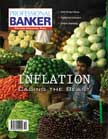
Inflation
: Caging the Beast
-- Katuri Nageshwar Rao
In his recent review, the Governor of Reserve Bank of
India, has opted for a tight monetary policy. Indian inflation
has both supply side and demand side issues to tackle. While
long-term fiscal measures are needed for supply side issues,
the RBI's ability to manage larger money supply through its
monetary instruments is proving to be less effective in a
globalized financial environment.
© 2008 IUP . All Rights Reserved
INVESTMENT
BANKING
Chaos
on Wall Street : An Accident Waiting to Happen
-- T Kiran Kumar
The
complex financial products have produced severe imbalances
world over, indicating that regulators face a truly difficult
task ahead to tide over the challenges. A series of banking
failures is threatening the entire system, and may have dire
consequences in the near future.
© 2008 IUP . All Rights Reserved
SOCIAL
BANKING
Financial
Inclusion : A Global Perspective
-- A K Sohani
Today,
not only in developing countries but also in developed countries,
most people still do not have access to the basic financial
services. The increased evidence points to the fact that increased
access to financial services can promote faster economic growth
leading to poverty reduction and parity in income. As a consequence,
promoting financial inclusion has become the primary goal
of many countries.
©2008 IUP . All Rights Reserved
SOCIAL
BANKING
Banking
for the Poor
-- V Jagan Mohan
There
has been a great deal of public discourse and literature on
financial inclusion in recent times. The Rangarajan Committee
on financial inclusion has dealt with the matter exclusively
with several suggestions. The matter has also received the
attention of high-powered Committee on Financial Sector Reforms
(CFSR) constituted by the Planning Commission and headed by
Raghuram Rajan, Professor, University of Chicago, US.
©2008 IUP . All Rights Reserved
RECOVERY
MANAGEMENT
Bad
Loans May Still Mean Good Business for Banks
-- Rajeswari Krishnan
With
the RBI regulations for the sale of bad loans, banks appear
to pass on their heavy burden of NPAs and make some hot cash
in the process. Market analysts say that with the slowing
down of the economy, the bad loan market may gain momentum.
© 2008 IUP . All Rights Reserved
SCENARIO
Credit
Cards : Frauds and Precautions
-- S Anitha
Information
technology, infrastructural back-up and networking in the
country have enabled banks to provide transaction settlements
through financial cards such as credit cards, debit cards
and ATM cards as well as smart cards to their customers. These
plastic cards have given a new shape to money with instant
liquidity, constant flow of funds and added convenience. These
cards have provided the users with many benefits but the chances
of incurring losses through frauds are also high.
© 2008 IUP . All Rights Reserved
E-BANKING
Dos
and Don'ts for Protecting Your Banking
-- Marzun E Jokhi and Delnaz M Jokhi
Some of us prefer to go to the banks personally to take
care of our banking activities whereas some prefer to carry
out the transactions through online banking. We all face the
danger of falling victim to frauds. This article attempts
to remind customers to be constantly vigilant for protecting
their personal and financial information.
© 2008 IUP . All Rights Reserved
TECHNOLOGY
IT
Initiatives in e-Banking and its Security Aspects
-- A Sarangapani and T Mamatha
Information Technology (IT) has become an integral part
of the banking system. With the help of IT, the banking industry
is able to meet customers' requirements efficiently. The major
issue causing concern for extensive application of IT in banking
relates to e-security threats in the form of cyber crimes,
frauds, thefts, etc. This article discusses the recent developments
in the Indian banking industry, various IT initiatives, e-security
aspects, cyber laws and the RBI guidelines to regulate the
e-security issues.
© 2008 IUP . All Rights Reserved
TECHNOLOGY
Online
Banking : A Paradigm Shift
-- R Bhavani and V Prakash
Online
banking is one of the emerging technologies, which is beneficial
to financial institutions as well as their clients. It enables
a person to carry out his transactions through the Internet,
irrespective of time and place. The comfort provided by this
technology is that people need not visit the banks personally.
The Internet not only provides the facility to shop and communicate
online, but also bank online. Making deposits, withdrawals
and paying bills are now just a click away.
© 2008 IUP . All Rights Reserved
ECONOMY
Setting
the Economy on Fire
--
Parul Bhatia
This
article throws light on the burning topic in the economy:
Inflation. It seems that it will gradually halt the growth
of Indian economy if serious steps are not taken to deal with
it. The targeted GDP growth rate of 9% clearly unattainable
with the impact of rising prices in spite of good business
done in India. Though the Reserve Bank of India has taken
several steps to contain the menace, the inflation continues
unabated and has reached an alarming 12% mark.
©2008 IUP . All Rights Reserved
REGULATION
Anti-Money
Laundering Measures and Know Your Customer Standards : Protecting
Safety and Soundness of Banks
-- D Ramani
The
globalization of financial markets, dismantling of controls,
capital mobility and technological advancement have exposed
banks to the risk of criminal misuse for laundering of illegal
proceeds. In a deregulated environment, with more operational
freedom devolving on banks, the risk of being unwittingly
used as intermediaries for the transfer or deposit of funds
derived from criminal activity is accentuated.
© 2008 IUP . All Rights Reserved
STRATEGY
BCG
Matrix : An Innovative Cross-selling Tool in Banking Sector
-- Sumeet Gupta and Esha Sharma
BCG
matrix provides a competitive framework for businesses, based
on the market share of the company and the growth rate of
the industry. Indian banking, which has been swept by retail
lending revolution, needs to understand the drivers of competition
and leverage on its strengths to acquire higher market share.
This challenge involves effective use of the customer relationship
management and cross-selling opportunities.
©2008 IUP . All Rights Reserved
|