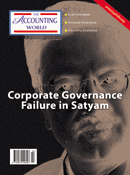
COVER STORY
Corporate Governance Failure in Satyam
-- S Suyampirakasam
Satyam fraud is unfolding and is a glaring example of corporate governance failure. Ramalinga Raju's
emotionally charged letter shook the entire corporate world when he admitted to fabricating the accounts and inflating the figures
by Rs. 5,040 cr. The scam is comparable to that of Enron of US because even in this case, the scam was made up by
its auditor, PricewaterhouseCoopers. The scam has raised many questions about corporate governance practices in
India. There are certain elements of corporate governance, namely, independent directors, regulators, auditors, as well
as CEOs.
© 2010 IUP. All Rights Reserved.
HUMAN RESOURCE ACCOUNTING
Human Resource Accounting
-- Burla Nitin Niranjan
Human resources were always considered as liabilities but in the evolving scenario, organizations have started
recognizing them as assets. For valuation of human resources, Human Resource Accounting (HRA) is being used by a few
organizations. This concept is still in a developing stage. We know that every coin has two
sides, and similarly, HRA has its own advantages and disadvantages. If human resources are to be valued correctly, then organizations can use this data as a
tool for future decision making in matters related to human resources which is directly connected to the profitability
of organization. As this concept is still in a nascent state, there is no formal method as yet, which is universally accepted.
This article focuses on the development of the concept, definition, importance and
limitations of HRA.
© 2010 IUP. All Rights Reserved.
ACCOUNTING STANDARDS
IFRS and Its Adoptability Worldwide
-- SK Chaudhury
In the era of Liberalization, Privatization and Globalization (LPG), convergence with IFRS is the need of hour. In
India, it is necessary to adopt the provisions of IFRS in order to develop consistency with the regulatory and
economic environment. IFRS is set to become universally acceptable. The evolution of IFRS can be said to be a major event in
the area of financial reporting. On a worldwide basis, Accounting Standards (AS) are used as necessary rigid
mechanism tool for grounding purpose for the preparation of financial report, as well as audit purposes. The present article
highlights the role of AS across the world and harmonizes the AS of different bodies. It also discusses the challenges involved
in the adoption of IFRS and the convergence of AS with certain suggestions.
© 2010 IUP. All Rights Reserved.
FINANCIAL REPORTING
Derivatives Accounting: An Introduction
-- Vikas Shrotriya
There is an array of investment avenues available to investors as per their risk-taking capability. An intelligent
investor understands that as risk increases, the probability of higher returns increases and there is no certainty of such
higher returns. The whole investment activity revolves around risk reduction, if not elimination. Investors formulate
various strategies to reduce risk. One such strategy can be to invest in derivatives. Derivatives are instruments, which
derive their value from some other variable and not from themselves. The value of derivative is derived from the
underlying variable. This article discusses some aspects of derivatives.
© 2010 IUP. All Rights Reserved.
TECHNOLOGY
XBRL: The Road Ahead
-- Pratik Niyogi
XBRL is a new technology of financial reporting. It is known as eXtensible Business Reporting Language. It
will streamline the financial information, making it available for those who need it. It will make more effective use
of financial data, providing higher quality and more accurate information, which will make it much easier to
compare companies or various documents within the same company. With XBRL, much of the work is automated, which
helps in reducing the turnaround time while producing the financial statements.
© 2010 IUP. All Rights Reserved.
FACTORING
Accounting Treatment of Debtors Factoring
-- Ricky van der Walt
Factoring is a popular mechanism of managing, financing, and collecting receivables in developed countries like the
US and UK, which has also been extended to a number of other countries in the recent past, including India. Factoring
is a unique financial innovation. It is both a financial as well as management support to the client. It is a method
of converting a non-productive, inactive asset into a productive asset, by selling receivables to a company, which
specializes in the collection as well as monitoring of receivables.
© 2010. This article was first published in December 2009-January 2010 issue of Accountancy SA (www.accountancysa.org.za). Reprinted with permission.
IFRS
The Effect of IFRS on the Tourism and Hospitality Industry
-- Atul Bansal
The implementation of Accounting Standards (AS)
can neither be forgotten nor can it wait for long. The world,
today, requires International Financial Reporting Standards (IFRS), a common accounting language for
presenting financial statements. It is expected that more than 150 countries would follow IFRS by 2011. India should also set up
an action plan for enjoying the benefits of IFRS convergence. IFRS is not only going to help Indian companies
benchmark their performance with their global counterparts but will also help them avoid filing multiple reports for
those companies, which have gone global.
© 2010 IUP. All Rights Reserved.
SPEECH
Speech by SEC Commissioner: "The American Corporation and Its Shareholders: Dooryard
Visits Disallowed"
-- Elisse B Walter
Commissioner,
US Securities and Exchange Commission,
San Diego, California.
Corporate governance is important from the shareholders' perspective and is at a critical juncture. Legal and
regulatory systems are undergoing thorough changes. Much attention should be paid on matters affecting corporate
governance, with particular focus on voting reforms designed to strengthen shareholders' rights, corporate disclosure
improvements related to compensation policies, and incentive arrangements. Also, attention should be paid on disclosures related
to compensation structures and practices of risk taking. Directors' nominee qualifications, company leadership
structures are also paid attention in this regard.
© 2009 US Securities and Exchange Commission (www.sec.gov). Speech by Elisse B Walter, Commissioner, US Securities
and Exchange Commission, Conference Co-sponsored by Society of Corporate Secretaries and Governance Professionals, San
Diego, California, June 27, 2009. Reprinted with permission.
|