COVER STORY
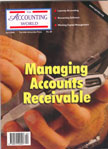
Managing Accounts Receivable in a Sink-or-Swim Economy
-- Ravi Surya Subrahmanyam
Accounts receivable are book debts payable to a company by its clients. Book debts are a part of the current assets on
the balance sheets. The base behind managing receivables depend on sound policies for credit sales. Collection from debtors is
the toughest task of Accounts Receivable Manager. Because of economic slowdown, bad debt rate may increase. Consequently
the job of Receivable Management may become quite significant in today's adverse economic and business situation. This
article explains the importance of a sound accounts receivable policy.
© 2009 IUP. All Rights Reserved.
ACCOUNTING
Layaway Accounting
-- TN Ramakumar
Cash and credit sales are perhaps as old as the first ever human mercantile transaction. Layaway sale, thus, refers to goods
or merchandise that are sold on deferred terms and, thus, laid away. The laid away items are treated separately from cash and
sale stock items. Layaway sales are a form of credit-cum-cash sales and as such accountants look at it from a different
perspective. Such treatment by accountants is invariably influenced by the locus of revenue recognition norms under which they
operate. The article touches upon some allied issues and throws up instances and issues from the Indian and the US contexts.
© 2009 IUP. All Rights Reserved.
FAIR VALUE ACCOUNTING
Fair Value Accounting: Is it Really Fair Accounting Practice?
-- K Saikrishna
The article primarily focuses on applicability of Fair Value Accounting (FVA) in the light of global financial crisis. The article
is broadly classified into three sections. Firstly the important accounting methods for the valuation of assets and liabilities such
as historical cost method and net realizable cost method are critically evaluated with a special focus on the limitations of
the historical cost method and evolution of FVA method. The second section of the article presents the role of FVA in fueling
the financial turmoil and how the FVA made the hot markets even hotter and cool markets cooler. In the third section, the
main issues discussed are the recent arguments against the application of FVA in financial reporting by the bankers all over the
world. Ultimately the latest study reports and opinions expressed by the Securities and Exchange Commission (SEC) on the role of
FVA on financial crisis are included.
© 2009 IUP. All Rights Reserved.
BUSINESS ENVIRONMENT
2009 – A Good Year for Corporate Users of
Payment Services
-- Tom Buschman
In responding to the changes brought about by Single Euro Payments Area (SEPA) and the Payment Services Directive (PSD)
in Europe, corporate users have a lot to learn from similar payment services initiatives in other countries, such as Australia.
© 2009 gtnews.com. This article was originally published in gtnews.com in January 27, 2009. Reprinted with permission.
AUDITING
The Gray Area of Bias
-- James L Gunn
Revised international standards on auditing tackle possible bias in accounting estimates. Auditing financial statements has
never been a matter of following a strict, rules-based approach. This is true not only because of the fundamental nature of an
audit itself, but also because of the need for the auditor to evaluate the various judgments management has made in
applying accounting rules to an entity's facts and circumstances when preparing the financial statements.
© 2008 CA Magazine. Originally published in CAMagazine.com, May 2008. Reprinted with permission.
AUDITING
The Five C's of IT Policy: Reviewing the Effectiveness of Security Policies and IT
Audit Plans
-- Ishwar Chandra
Organizations need a robust information security system that ensures data integrity and confidentiality, protects
information assets and encourages efficient and effective use of information system. An information security policy approved by the
highest level of management, is an initial step towards increasing awareness of security needs. As a part of the IT audit program,
senior management expects internal auditors to provide assurance that suitable information security mechanism are in place to
comply with law and regulation. An effective policy may provide a false sense of security. However it can yield tangible and
intangible pay-offs, such as effective control monitoring, timely detection of breaches and reduced losses and legal sanctions. Such
gains enhance stakeholders' confidence in the organizations.
© 2008 Ishwar Chandra. The Institute of Internal Auditors. Originally published in www.theiia.org, ITAudit.com.
Reprinted with permission.
TECHNOLOGY
Accounting Software: Restructuring the Accounting World
-- Shalini Agarwal
In the present era, the map of the business world is totally different from that only one or two decades ago. In present times
it is essential that its accounting system must be efficient, providing accurate information at the right time. Accounting
Software plays a vital and crucial role in managing the business affair effectively and efficiently. This article reflects how
Accounting Software have replaced manual accounting system by developing the new automated accounting system by Accounting
Softwares. Accounting Softwares allow automated recording of financial transactions of business on computers and generate
financial report showing the accurate figure of each account, assets and liabilities and should be selected according to the size and
needs of the business to make it more efficient and effective.
© 2009 IUP. All Rights Reserved.
Business Environment
Working Capital Management in Gujarat Cooperative Milk
Marketing Federation
-- Ashutosh Verma
In India, the cooperatives have played a major role in the growth of the dairy sector and in making India the largest
producer of milk. While the government initiated liberalization in 1991, the opening up measures in dairy sector started in 1998,
which resulted in large corporates entering the sector. Of all the cooperatives, Gujarat Cooperative Milk Marketing
Federation (GCMMF), which is the largest cooperative in dairy sector and has a substantial market share, had to gear up to face
the increasing competition. This article attempts to identify whether the liquidity management and the financing of working
capital of GCMMF have undergone change or not in the second phase (1998-2004) vis-à-vis the first phase
(1991-97) of liberalization.
© 2009 IUP. All Rights Reserved.
IFRS
IFRS Readiness
-- Jeff Buckstein
All businesses and individuals increasingly make decisions in the global context. The focus of International Financial
Reporting Standards (IFRS) is to improve financial reporting internationally, by establishing a single set of high quality, consistent
and comparable reporting standards. In today's increasingly global economy, relevant, reliable, clear and consistent
financial reporting will offer an improved basis for decision-making for businesses and investors. January, 2011, is the expected
changeover date at which IFRS will replace Canadian GAAP for all publicly accountable enterprises.
© 2008 CGA-Canada.org. This article was orginally published in CGA-Canada.org on
September-October, 2008. Reprinted with permission.
BUSINESS LAW
Revisiting the Provision of Statutory Minimum Paid Up Capital
-- G Mahaveer
The issuance of amended Section 3 of Companies Act 1956, makes statutory minimum paid up capital as sine qua non for
any registered Company. But other provisions in force, such as Sections 12, 37(1), 160 and Schedule X, etc., still adumbrates
the existence and formation of Companies sans Share Capital. Though at present the contradiction stands harmonized by
the general rescuing clause of Section 3`Unless the context otherwise requires', still the need is to amend Section 3 in
order to specifically exempt companies without Share Capital from the purview of Minimum Capitalization norms just on the lines
of how Section 25 Companies are exempted.
© 2009 IUP. All Rights Reserved.
|