Dec'18
The IUP Journal of Entrepreneurship Development
Archives
Kevin Plank and the Rise of Under Armour
K B S Kumar
Assistant Professor (Organizational Behavior),
IBS Hyderabad (Under IFHE – A Deemed to be University
u/s 3 of the UGC Act, 1956), Hyderabad, Telangana, India.
E-mail: kumar@icmrindia.org
Indu Perepu
Coordinator,
Case Research Center – City Unit,
IBS Hyderabad (Under IFHE – A Deemed to be University
u/s 3 of the UGC Act, 1956), Hyderabad, Telangana, India.
E-mail: indup@icmrindia.org.
The case captures the entrepreneurial initiatives, inventions and growth story of Kevin Plank, who, in 1996, founded the firm Under Armour, a sports apparels firm which went on to take on the bigwigs like Nike and Adidas. The case is about the genesis of Under Armour and the various entrepreneurial aspects like product innovation, product branding, marketing, communications, etc. Under Armour's Sweat Wicking Cleats were placed not as mere sports apparel, but promoted as a performance enhancer—which struck the right chord with the target audience. The branding and positioning strategies ranged from sponsoring tournaments, sporting in movies, viral marketing, etc. The case captures the various marketing and branding strategies that Plank adopted to promote Under Armour's brand and its products. The competition in the sports apparel industry was fierce and had immense potential to affect Under Armour. The case also captures the challenges Under Armour faced, viz., competition, lack of continuous innovation, lack of patenting, etc.
I was always smart enough to be naive enough to not know what I can't accomplish.1
When we think about our competition we aren't worried about the next shoe that someone is going to build, we are thinking about the competition that doesn't exist yet and we are thinking about it from a digital perspective.2
–Kevin Plank,
Founder and CEO – Under Armour
Introduction
In 2010, Forbes had adjudged Kevin Plank (Plank), founder and CEO of the US-based sports apparel maker Under Armour (UA), as one of the 15 most powerful American chief executives aged under 40. Plank was also ranked 14 in the 40 under 40 list of Fortune.3 Plank, a footballer by passion and businessman by profession, had founded UA in 1996 with the groundbreaking idea of a sweat-wicking T-shirt that shook the sports apparel industry. The uniqueness of the product and the charisma of Plank earned UA early success.
Through strategic growth drivers, viz., the R&D, innovation, aggressive marketing, and strategic alliances, UA under Plank's leadership, created a robust brand out of nowhere in 15 years. In 2005, UA made a sensational debut on the NYSE, as its stock appreciated by at least 100% during its very first day of trading. The shares opened at $31, which was more than double its $13 price. UA raised $157 mn through the IPO.
Despite its remarkable success with its maiden product the sweat-wicking T-shirt, UA was still not immune to threats from the competition for various reasons. Factors like imitable product, lack of patents, limited target segment, unrelated diversification, and product failures still kept UA struggle to grab a pie in the market share from the giants like Nike and Adidas. Moreover, the daunting competition from sports apparel majors like Nike, Adidas, and Lululemon kept UA on its toes.
The Beginning
Plank, born in 1972, grew up with four older brothers who, right from childhood, compelled him to constantly struggle to secure his interests. Plank was not great at academics. During his high school days, Georgetown Preparatory School rusticated him for poor academic performance. As a result, Plank joined Fork Union Military Academy, where he started playing football with the aspiration of becoming a professional football player.
Toward the end of college, Plank had a job offer in hand from Prudential Life Insurance. Plank, whose inclination for sports had grown immensely during the schooling phase, was not interested in taking up a job that would take him away from sports. Had he accepted the job and settled for it, he said, "I would have killed myself."4
Plank went on to attend St. John's College High School. He graduated from there in 1990 and aspired to become a college football player. As he fell short on certain criteria like height and health to become a player, he opted for a postgraduate year back in Fork Union Military Academy. The school was well-known for its football players rather than for academic excellence. This proved to be a great advantage for Plank, who was lucky to have a class loaded with high caliber football players. 13 of Plank's teammates went on to play in the NFL. Many of those would become brand campaigners of UA, Plank's soon-to-be company.
Salesman by Nature
In 1991, Plank entered the University of Maryland's Robert H Smith School of Business and managed to join the football team in his freshman year. As the National Collegiate Athletic Association5 (NCAA) football players were barred from employment Plank could not get into a job. Selling was Plank's innate strength. Plank started a rose-selling business—Cupid's Valentine Rose Delivery—in his freshman year targeting Valentine's Day. The business was a runaway success. Plank managed to sell 100 dozen flowers the first year, 250 dozen the second year, and 600 and 1,100 dozens in the third and fourth years respectively.
Though it was a simple business, it offered several early business lessons to Plank, helping him understand the intricacies of accounting, managing people, the importance of marketing, the right way to advertise and reach the target audience, and, above all, customer service. The bottom line lesson Plank gathered from the experience was, in his own words, "You're responsible—there's nobody else—for every last detail".
By the fourth year of college, Plank was managing the rose business with more than 50 staff spread out among different functions like customer service, packing the roses, and delivering them.
After his initial success in the floral business, Plank was all set to move on to the next product. In the early 1990s, the Terps (The Maryland Terrapins), the team Plank represented, had an impressive start with a 4-0. They occupied the 16th rank in the country and were looking forward to playing their first night game against Georgia Tech. The Terps met with a miserable defeat at the hands of Georgia Tech. They bounced back but the finish was unimpressive for them with six wins and a disappointing five losses.
Opportunity Identified
In light of his disappointing experience, Plank had a couple of issues that deeply engaged his thinking. He was not sure about his future in football; also, he wondered why they did not have a better T-shirt underneath the football uniform that would give a comfortable on-field experience. Plank felt that the footballers' uniform T-shirts soaked up a lot of sweat, which made them heavy and extremely uncomfortable to wear.
Playing on field at the end of a game was a challenging task. The sweat-soaked heavy T-shirts made it all the tougher. A dry cotton T-shirt weighed about six ounces.6 A T-shirt soaked in sweat weighed two to three pounds. The question, "Could there not have been a technology that offered a comforting experience while on the field?" kept running through Plank's mind.
Earlier, US-based conglomerate DuPont had attempted a similar product as a part of its CoolMax series, only to realize that the product could not be sustained as it relied too heavily on evaporation. This prompted Plank to think of something else along those lines, which could become his next business interest.
In 1995, the last year of his graduation, Plank started experimenting with his idea. He approached a local fabric maker and found a material which seemed ideal for fabricating his shirt. He got several samples made. However, the samples fell apart as the cotton thread did not stretch along with the material. But the fabric itself did work as it could wick moisture.
Plank discovered the core fabric that provided a solution to his challenge. Next, there was an enormous amount of groundwork to be done to translate his vision into reality. Plank began gathering information about manufacturing the shirts. He made several inquiries about the manufacturing material and processes and made several connections in the process with pattern makers and fabric wholesalers.
Plank bought enough material to manufacture 500 samples for the T-shirts. Like Adidas' revolutionary creation of the football cleat in 1954 and Nike's game-changing waffle-print running shoe, Plank also came up with his research-based ground-breaking innovation—the sweat-wicking T-shirt. Being a footballer himself, Plank invented just the product needed. Plank firmly believed that those who succeeded in the long run in any business, were the ones who created products through R&D and innovation rather than products that were totally dependent on the sales and marketing department.
Plank's shirts weighed three ounces when dry and seven to eight ounces when wet. That was quite a promising difference, assuring comfort to the players on the field. These shirts wicked away moisture, leaving the athletes cooler, fresher, and two or three pounds lighter than their opponents. That was the T-shirt's unique selling proposition that could be pitched against bigwigs like Nike and Adidas. Plank's goal was to attain the competitive advantage of outperforming rivals on the basis of distinguishing features, such as product categories, superior quality, and technological edge. However, to Plank's dismay, most companies immediately rejected his idea. However, there were some who saw a spark in young Plank's passion and volunteered to buy his idea of the sweat-wicking T-shirt.
Plank presented sample packages of his T-shirt to all his friends at the Terps as well as other players who had by then become pros. He gathered the names of the equipment managers through his friends at Terps and sent samples to all of them.
Further, he began road trips toward the south of the US, which was hotter and where people sweated a lot. There, he targeted all the Division-1 schools he could access. With his costs rising, and no indication of immediate revenues, it looked like Plank was sure to go broke. However, what bothered him more was the feedback he would receive from those to whom he had distributed the T-shirts.
UA Is Born
In 1996, Plank, along with Ryan Wood, a former NFL player, founded the firm Under Armour. Plank initially named the product Body Armour. However, he was disappointed when he realized that the name was already owned by several product makers, body-shops, bullet-proof makers, etc. In a serendipitous incident, Plank paid a visit to the office of his brother Bill, who greeted him with, "How is Under Armour going", thinking that was the name of the company. The name immediately struck a chord with Plank. He felt as if the name Under Armour was just apt for his product. After ensuring that the name was still unused, Plank finalized it as the name of his company.
Plank was not in a position to pay millions of dollars to get a logo designed for UA. However, he had access to talented designers through his friends. Plank had a vision in his mind about the logo. He wanted something absolutely simple and emphatic that reflected the very purpose of UA.
One of his acquaintances started working with a heavy design that included a shield with Atlas carrying the globe on his shoulders at the center. Plank, who wanted something simpler, then passed on the task to another friend, Nora Olson (Nora), who started working on the design. He asked Nora to focus only on the corner of the shield, removing Atlas and the Earth. What emerged was a simple logo with the letter 'U' and 'A' vertically locking with each other. (Refer to Exhibit I for Under Armour's Logo).
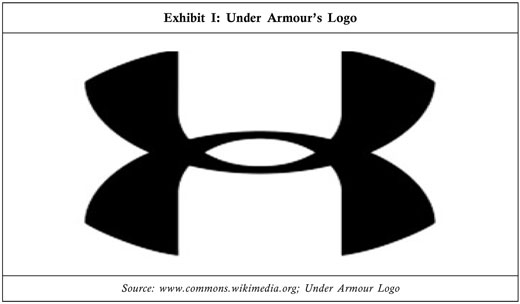
The logo looked convincing and impressive to Plank. He looked at it as a symbol of balance—the top being the same as the bottom and the left being the same as the right. It justified the company's mission of keeping a balanced body temperature and the players' maintaining their composure on the field. The year 1996 was when UA was officially founded as a company.
Brand Recognized
Plank had a serious concern. Almost all the equipment managers to whom he offered the T-shirts were not convinced about it. The primary reason, according to Plank, was the price. UA products were priced higher than those of the competition. However, quality and innovation were the two primary components to position the UA brand. The UA brand was positioned as being of the highest quality and the best available.
The equipment managers were not ready to pay five times what they paid for their regular T-shirts (which cost $5) for the value that UA's T-shirt offered. Plank continued his search for evangelists who could spread the word in favor of UA's T-shirt. In the summer of 1996, Plank was completely broke—to the extent that he found it tough to even make ends meet. He had to fall back on his mother for a square meal.
But there were good times around the corner for Plank. In a season of sweltering heat, Georgia Tech became the first college team to sign on UA. And suddenly, Plank started getting the first round of inquiries and orders. It began with the equipment manager for the Atlanta Falcons who inquired for shirts with long sleeves. That was followed by the equipment manager from Arizona state inquiring about shirts for cold weather.
The year 1997 was a big one for Plank. His efforts brought visible results. Arizona State had played in the Rose Bowl, the annual American college football bowl game7, and the whole team was wearing Under Armour. This drew the audience's attention and had them wondering about the new product that the whole team was wearing. The brand thus received a significant amount of recognition from sports lovers and players.
In the same year, Ryan Wood (Wood) who co-founded Under Armour with Plank, approached the local police departments and pitched the product at roll call. The shirts gained instant popularity. Going forward, the police and law enforcement officers became prime customers for UA, accounting for 5-10% of UA's sales in the US.
Initial Funding
Kip Fulks (Fulks), who joined UA as a partner in 1997, played a major role in its expansion. Fulks did not play football; he played lacrosse. The conditions under which lacrosse players played were even more rigorous than those under which football players played, as they had to run harder, in hotter weather, and for longer stretches. Fulks was convinced that UA's T-shirt was really needed in lacrosse. He bought into Plank's vision and spread the word across to the lacrosse world. This further enhanced UA's customer base.
Plank hired Fulks for a $200 per week salary. During the next couple of years when UA was yet to take off and Plank ran out of funds, Fulks allowed Plank to use his credit cards to meet the expenses of the company.
In 1998, Plank was able to secure his first SBA (Small Business Administration) loan of $250,000 from Kate Carr, a banker at Adams Bank, who later loaned him some more funds in small portions. The same year, Plank shifted UA's office to a 2,000 square foot facility. He received further financial assistance from his older brother Scott, who went on to own 4% in UA.
By 1998, Plank had started receiving regular orders. He had to meet the prospects frequently. However he shied away from meeting visitors in his office due to the mess created by the merchandise lying around. Whenever he had a call from a prospect wanting to pay a visit to his office, he drove them into a restaurant, saying that he was not at office that day. Plank firmly believed that a big and successful life can happen only if you see it and live it already—at least pretend to live it'.
UA's Compelling Uniqueness
UA's product was catching on. By 1998, nearly a dozen NFL teams had started using its T-shirts. The initial experience of the UA costumes wearers was often embarrassing. The NFL athletes who wore the UA costumes were often mocked by teammates. The costumes attracted comments like: 'What the heck are you wearing?', 'Are you kidding me?', etc. However, when the mockers came back into the dressing room drenched in sweat, with heavy costumes to find the UA wearers looking stunningly clean and fresh, the questions changed to: 'What is that thing?' 'Do you mind if I try it?' It spread from one person to another, extending to the whole side of a locker room and finally to the whole team. Likewise, UA relied mostly on viral marketing as it believed in the authenticity of its product.8
The UA costumes started spreading from Atlanta Falcons, to the NY Giants to the Jets. And the wave continued.
The uniforms became visible enough to cause a sense of unease among the more established brands. The teams were not allowed to wear non-branded stuff as the managements had signed multi-million dollar contracts with the popular brands like Nike and Adidas. However, the players of the teams were keen on wearing UA's apparel as Plank's product and its promising results prevented the players and managements from removing the T-shirt.
Following the pressure from the bigger brands, NFL called Plank and asked him to send his products without the UA logo. That of course did not go down well with Plank. When he asked, how NFL expected him to do that, its response resulted in an unexpected bargain for him. NFL's representatives promised Plank a license for NFL Europe if he agreed to its request. For Plank, that was not a bad bargain at all. UA got the license free of cost. That was the beginning of the company's journey beyond the US. In addition, UA received enormous exposure and people started inquiring about the makers of the long sleeve T-shirts.
This experience expanded Plank's business cycle, which focused on the football season at that time. The deal offered him the much needed movement in the inventory, the revenues, and most importantly, global exposure and at a cost that Plank had not expected in his wildest imagination.
By 1999, UA had attained a reasonable growth trajectory, and had reported impressive growth figures. UA was a $25 mn firm with a strength of 125 people against 75 the previous year.
Plank's business strategy revolved around football strategy. To him, sales were offense and operations were defense. He was humble enough to realize his weak areas and to hire talent to fill in the gaps.
Plank was aware that he had to step with utmost care, especially because of the spurt of growth the firm had witnessed. He was clear that he would not allow his eyes to get glazed over by greed. He was particular about keeping himself grounded and to be supported by a good, solid business foundation.
The Hollywood Breakthrough
One of Plank's friends had referred to an upcoming football movie being shot in Miami. The movie was Any Given Sunday by Oliver Stone that had a huge star cast including Al Pacino, Cameron Diaz et al. On an impulse, Plank called and found out the movie's production location and couriered to them a box of UA's gear. A few days later, he received a call from Oliver Stone's office saying that they loved the gear and would pay $30,000 for the box of gear.
Plank also brought out a half-page ad in ESPN The Magazine at a cost of about $25,000, which was way beyond UA's budget. Despite the cost and the staff being against it, Plank decided to go ahead with the advertisement as he saw that it would coincide with the movie's release. To Plank, it was essential to tell the UA story to the world, rather than just selling the product. The stunt paid off. UA's signature product, the body-hugging shirts and shorts that wicked sweat from the body, was worn throughout the film. It was a dream come true for the small startup founded by Plank, giving it a chance to get its brand out in front of tens of thousands of people. It was also the beginning of UA's growing relationship with Hollywood.
Year 2000 proved to be a launching pad for UA. The result was $5 mn in sales. UA's maiden big order came in 2000, when Galyan's, a large retail chain which was bought out by Dick's Sporting Goods, signed on. Going forward, Dick's (19%) and the Sports Authority (9%) put together accounted for 28% of UA's sales for the year 2000-01.
Product Placement
UA fared very well in its product placement. Its products were placed so effectively that movie makers and ad makers felt that brand UA added value and authenticity to their shows. Many producers did not even ask for payment. They just wanted the product. Product placement was a key part of UA's marketing strategy. The product was placed not as mere sports apparel, but was promoted as a performance enhancer—which struck the right chord with the target audience. Plank's job was not to just sell the apparel, but to create a movement—a larger agenda that would have a greater impact.
The product placement strategies ranged from paying to have UA gear worn in a movie to be part of an advertising package. Plank was particular about not promoting the UA's apparel as the regular product placement like Nike or Adidas did.
Brand Building
Plank was ambitious about extending the brand, yet he wanted to do it sensibly without going randomly into products which would dilute UA's image. To Plank, the products had to be in alignment with the company's mission, i.e., 'to help athletes perform better'. Plank had a maniacal focus on performance. Even initially, his vision was to make the best performance T-shirt rather than making a football T-shirt. The promise to the customer was performance and not just a garment.
Many underestimated the strength of UA. UA's strategy of "viral marketing" became an exemplary approach to many in similar businesses.
Plank had an unconventional opinion about brand endorsements by celebrity sports players. He did not believe in paid marketing. He felt that someone wearing your brand only because you paid him/her for it was inappropriate. Plank wanted the athletes to wear UA because it delivered the best results, not because it got them money. It did not make sense to Plank to pay out millions of dollars to the players and to plead with them to wear the company's stuff.
Plank felt that if the stuff was excellent, the players would definitely wear it. He believed in building a real brand which was genuinely owned by the players, rather than hiring celebrities to endorse the brand. To Plank, building a brand was not about savvy marketing campaigns. Brand was more about the uniqueness of a product. He looked at UA's T-shirts as indispensable because of its utility, and endurance. To him, brand was not something that was built by the sales and marketing departments; it was the product of research and innovation. For branding, he chose tangibility in performance over intangible catchlines.
UA's marketing involved no deception. It was pure viral marketing that relied on friends who sold the product to other friends because they loved it, not because they were paid. UA experimented with the viral marketing strategy in one of the most hostile environments—professional sports, where players were instructed what to wear as they were paid millions to stay loyal to the brands. UA's marketing strategy prompted several organizations to suddenly and furiously work to figure out how to become viral marketers. In 2002, Brian Morrison's Grant-a-Wish Foundation9 organized a lacrosse tournament for his children. The event faced a miffed response from their children when brand new lacrosse sticks were declared the first prize while UA's shirts were the third prize. The players felt the third prize should have been the first prize.
With its in-house marketing and advertising team, UA's marketing tactics paid off. Its next target segment was women, as Plank considered women better and more educated customers and a segment to which little attention had been paid by the apparel makers.
UA's first television advertisement was aired in 2003. It showed a football squad, sporting the UA sportswear, shouting, "We must protect this house."10 The phrase "Protect this house" became the signature of the UA brand. The professionals' endorsement resonated with aspiring players. It helped catapult UA to the position of market leader in performance apparel against giants like Nike, Dri-Fit, Adidas and Reebok.
In 2003, UA was ranked second on the Inc. 500 list11 and achieved $100 mn in revenue. In the seven years since its inception UA managed to create ripples across the sportswear industry. It had players like baseball stars Barry Bonds and Roger Clemens wearing its T-shirts and also some 100 college football teams.
UA Goes Public
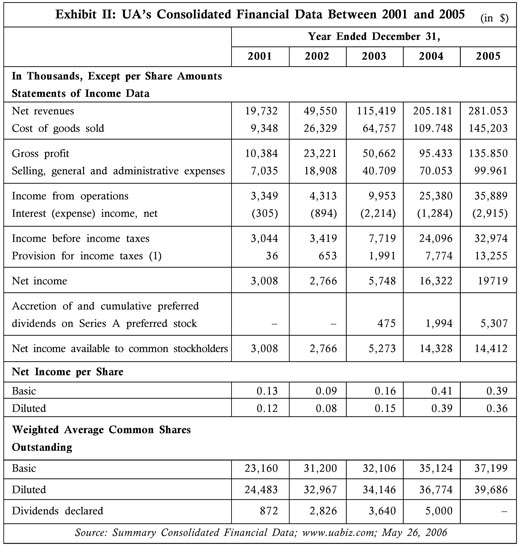
By 2005, UA had amassed a significant amount of brand equity vis-à-vis its arch rivals, Nike and Adidas.12 Its revenues grew from less than $50 mn in 2002 to $205 mn in 2004. (Refer to Exhibit II for UA's consolidated financial data between 2001 and 2005).
People started perceiving the UA T-shirt as performance apparel rather than a mere sports costume. In 2005, UA went in for an IPO. The process was managed by Goldman Sachs and was underwritten by CIBC World Markets, Wachovia Securities, Piper Jaffray, and Thomas Weisel Partners LLC.13 UA offered 12 million shares in the price range of $7.50 to $9.50 and planned to raise around $102 mn.
In November 2005, UA made a spectacular debut on the NYSE, as its stock emerged as the first US-based IPO in five years to appreciate at least 100% during its very first day of trading.14 The shares opened at $31, which was more than double its $13 price. UA raised $157 mn through the IPO. By 2005, UA's product portfolio had expanded beyond shirts. The offerings extended to shorts, underwear, outerwear, gloves, and other offerings through 8,000 stores, up from about 500 retail stores in the year 2000.
In the year 2005, UA reported a net income of $13.8 mn and revenue of $194 mn as against $12.7 mn and $136 mn respectively the previous year.
In about a decade, UA had achieved one milestone after another. Detectives in the HBO crime series The Wire, Golf characters in a Tiger Woods Golf video game, and the team of troubled youths and their coach in the movie Gridiron Gang, were among those who were seen wearing the UA uniform. In just a decade since its inception, UA vaulted to new heights from being virtually an unknown brand. Its products and logo were featured in films, TV shows, and video games like MTV Road Rules.
Plank left no stone unturned to fulfill his vision of building the world's greatest T-shirt. He put to use all the possible levers, viz., technology, strategy, innovation, marketing, advertising, and public relations and financing options to achieve his goal. In 2009, UA finished with revenues of $725 mn. In 2010, its stock was up 60% and sales were expected to hit $1 bn for the first time.
For the growth that followed the ground breaking innovation, in 2010, Forbes adjudged Plank as one of the 15 most powerful American chief executives aged under 40. He was also ranked 14 in the 40 under 40 list of Fortune.15
Challenges Ahead
Despite its stupendous success, UA was still not immune to threats from the competition for various reasons. The competition in the sports apparel industry was fierce and had immense potential to affect UA. The company had a narrow focus while marketing its products. With One Product (T-Shirt), One Market (Football) and One Target (Athletes) UA had restricted its scope to a smaller segment than its competitors.
UA's success had been largely dependent on its innovation. However, the company did not have registered patents for its innovation and that made its products imitable. It took hardly any time for biggies like Nike and Adidas to come up with similar products. Nike's Dri-Fit, which was similar to UA's sweat-wicking T-shirt, showed how vulnerable UA's product was.
One innovative product was not adequate for UA to withstand the severe competition in the sports apparel segment. Product extension was essential. UA diversified into Shoes—the category which Nike, followed by Adidas, dominated.
The diversification was unrelated to UA's category and its area of expertise. UA's flagship product, the sweat-wicking cleats, was hardly related to its Plank's invention, sports shoes. The diversification was also seen as a challenge UA had invited on itself. While the sweat-wicking football cleats took competitors like Nike by surprise, Shoes was the segment in which Nike was second to none. UA's feel of being invincible was visible in the big, bold launch of its shoes with a $25 mn campaign that declared "The Future is Ours!". That was no less than a challenge to Nike, which in no time responded with the launch of its new product SPARQ Trainer (for Speed, Power, Agility, Reaction, and Quickness.)
Eventually, UA's shoes were not perceived as the compelling and breakthrough product that its T-shirt was. By 2011, the shoes made up 12% of UA's revenue, which made it just 1% of the $14 bn US athletic footwear pie, as compared to Nike's 42% and Adidas' 11% market share.
Another challenge UA faced was its women's products. UA had been selling a women's collection since 2004. Despite this, by 2011, this segment was contributing to only 25% of its revenues. There were several possible factors cited for this. One was the company board's composition which was inclined toward males. Neither the board nor the senior executive team had even a single female representative. Competition was also immense from brands like athletic apparel retailer Lululemon.
With the internal and the external challenges affecting UA, it proved tough for it to get a larger market share. It remained to be seen whether the innovations that UA had in the pipeline could contribute to the company gaining a greater share in the sports apparel segment.
- Matthew Philips, "How Under Armour Tackled Nike and Adidas," www.newsweek.com, October, 2009.
- David Trites, "How Under Armour's Digital Transformation will Improve Your Health," www.forbes.com, February 11, 2016.
- Helen Coster, "15 Most Powerful CEOs," www.forbes.com, February 2010.
- Daniel Roberts, "Under Armour Gets Serious," www.fortune.com, October, 2011.
- NCAA regulates athletes of 1,281 institutions in the US and Canada. It is involved in organizing athletic programs in colleges and universities.
- One pound is equal to 16 ounces. One kilogram is equal to 2.204 pounds.
- Bowl Game is college football game in the US, played by NCAA teams.
- David Callahan, "No Sweat: How Kevin Plank and Under Armour are Infecting the Planet," www.smartceo.com, October, 2002.
- Grant-a-Wish Foundation was founded in 1983 with the aim of fulfilling the wishes of terminally ill children. It was founded by Brian Morrison, from University of Maryland.
- Under Armour, Protect This House, www.youtube.com, April, 2010.
- Inc. magazine, an American monthly publication, publishes an annual list of the 500 fastest-growing publicly held small companies in the US, called the "Inc. 500".
- Robert J Terry, "Under Armour Moves for IPO," www.bizjournals.com, August, 2005.
- Steve Gelsi, "UA's IPO Doubles," Marketwatch, November, 2005.
- Ibid.
- Helen Coster, "15 Most Powerful CEOs," www.forbes.com, February 2010.
Suggested Readings and References
- Lawrence Carrel, "Innovation's the Keyword", Investors.Com, January 2014.
- Trefis Team, "Armoured for Growth", Forbes, December 2013.
- Lawrence M Fisher, "Under Armour Muscles In", Kornferry, August, 2012.